Mobile App Development Trends: Preparing for 2023
As we approach the end of 2022, several trends in mobile development have matured from experimental to production-ready. Others are emerging as the technologies to watch in 2023. For Australian app teams planning their technical roadmap, understanding these trends is essential for making good investment decisions.
This is not a speculative piece about what might happen. It is an assessment of trends that are already in motion and will shape mobile development in the year ahead.
1. Declarative UI Is Now the Default
The shift to declarative UI frameworks is complete. In 2022, both Apple and Google made it clear that declarative UI is the future:
SwiftUI has reached a level of maturity where most new iOS apps should be built with it. iOS 16 and the fourth iteration of SwiftUI address many of the gaps that made earlier versions impractical for production. Navigation has been reworked. Charts are now native. The layout system is more flexible.
Jetpack Compose reached 1.0 in 2021 and has been rapidly adopted through 2022. Google is now building its own apps with Compose, and the library’s stability has proven itself in production.
Flutter continues its declarative-from-the-start approach, and its widget system remains the most mature declarative UI in cross-platform development.
What this means for 2023: If you are starting a new project, default to declarative UI. If you have an existing UIKit or XML-based app, plan a gradual migration. The declarative paradigm offers faster development, easier state management, and better previewing tools. Teams that are still building new features in UIKit or XML layouts are accumulating migration debt.
2. Kotlin Multiplatform Is Production-Ready
Kotlin Multiplatform (KMP) has moved from experiment to a viable production technology in 2022. Several large companies are now shipping KMP in production, sharing business logic between iOS and Android while keeping native UIs.
KMP’s approach is different from Flutter or React Native. Instead of sharing everything, KMP shares the layers where sharing makes sense:
- Business logic and domain models
- Networking and API clients
- Data persistence and caching
- Validation and data transformation
The UI remains fully native on each platform (SwiftUI on iOS, Compose on Android), ensuring the best possible user experience.
What this means for 2023: KMP is worth evaluating for teams that want native UIs on both platforms but are tired of implementing the same business logic twice. The shared logic approach reduces bugs (fix once, fixed everywhere) and development time without the performance and UX trade-offs of full cross-platform frameworks.
For Australian teams already using Kotlin for Android, the learning curve is minimal. The iOS side requires some Kotlin knowledge on the iOS team, but the benefits of shared business logic often justify this investment.
3. On-Device Machine Learning Goes Mainstream
2022 saw on-device ML move from a novelty to a practical feature in mainstream apps. The drivers:
- Hardware: The A15 and A16 chips in iPhones, and Google’s Tensor chip in Pixel phones, include dedicated neural processing units
- Frameworks: TensorFlow Lite, Core ML, and ML Kit are all mature and well-documented
- Pre-trained models: A growing library of pre-trained models means you do not need ML expertise to add ML features
Common production use cases in 2022:
- Image classification and object detection
- Text recognition (OCR)
- Natural language processing (smart replies, sentiment)
- Pose estimation for fitness apps
- Face detection and analysis
- Barcode and document scanning
What this means for 2023: Consider whether ML features would improve your app’s user experience. The barrier to entry is lower than most teams assume. Start with pre-built solutions like ML Kit before investing in custom models.
4. App Privacy Continues to Tighten
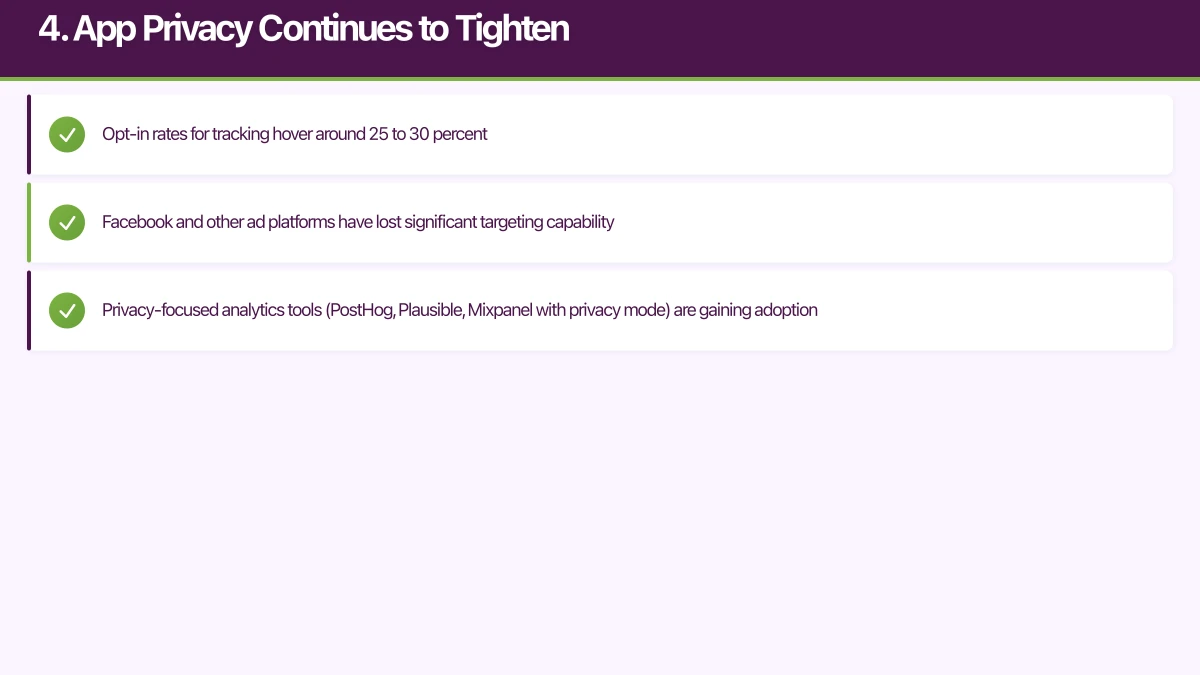
Apple’s App Tracking Transparency (ATT) framework, introduced in iOS 14.5, has reshaped mobile advertising and analytics. In 2022, the impact has fully materialised:
- Opt-in rates for tracking hover around 25 to 30 percent
- Facebook and other ad platforms have lost significant targeting capability
- Privacy-focused analytics tools (PostHog, Plausible, Mixpanel with privacy mode) are gaining adoption
Google is following Apple’s direction, though more gradually. Android’s Privacy Sandbox is in development, aiming to phase out the advertising ID while maintaining some advertising functionality.
What this means for 2023: Build your analytics and marketing strategy around privacy by default. Invest in first-party data. Use privacy-preserving analytics tools. Do not assume you will have access to cross-app tracking data. Australian businesses should also be aware of the ongoing reforms to the Privacy Act 1988, which may introduce stricter requirements for digital services.
5. App Clips and Instant Apps
App Clips (iOS) and Google Play Instant allow users to experience parts of your app without a full installation. These technologies have been available for a couple of years but adoption has been growing steadily.
Use cases that work well:
- Restaurant ordering (scan a QR code, order immediately)
- Parking payment (NFC tag triggers payment flow)
- Product demos (try before you install)
- Event check-in
What this means for 2023: If your app has a clear single-task use case that benefits from zero-friction access, consider building an App Clip or Instant App. The investment is moderate, and the conversion from clip to full app installation is strong when the initial experience is good.
6. Server-Driven UI
Server-driven UI (SDUI) is a pattern where the server controls what the client displays, sending layout descriptions rather than raw data. This allows you to update the UI without shipping an app update.
Companies like Airbnb, Lyft, and Shopify use SDUI for their mobile apps. The benefits:
- Instant updates: Change layouts without App Store review
- A/B testing: Test different UI configurations server-side
- Personalisation: Show different layouts to different user segments
- Reduced release risk: UI changes do not require a new binary
The trade-off is complexity. SDUI requires a protocol for describing UI, a rendering engine on the client, and a backend system for managing layouts.
What this means for 2023: SDUI is worth considering for content-heavy apps with frequently changing layouts (e-commerce, news, marketplaces). For most apps, a combination of feature flags and remote configuration achieves 80 percent of the benefit with 20 percent of the complexity.
7. The Subscription Economy Matures
Subscription-based apps now dominate the App Store’s top-grossing charts. In 2022, both Apple and Google have invested in better subscription management tools:
- Apple’s StoreKit 2 simplifies subscription implementation significantly
- Google Play Billing Library 5.0 streamlines the Android purchase flow
- Both platforms now offer better analytics for subscription metrics
- Win-back and grace period features help reduce churn
What this means for 2023: If your app has ongoing value, a subscription model is likely the right monetisation strategy. Invest in proper subscription infrastructure (server-side validation, lifecycle management, churn analytics) rather than treating subscriptions as simple in-app purchases.
8. The Rise of Super Apps in Asia-Pacific
While less directly relevant to the Australian domestic market, the super app trend in Asia-Pacific (WeChat, Grab, Gojek) is influencing how Australian companies think about app strategy, particularly those serving the APAC region.
Mini-programs and in-app platforms allow third parties to build lightweight apps within a host app. Apple and Google’s app store models are being challenged by this alternative distribution method.
What this means for 2023: Australian businesses targeting APAC markets should monitor super app platforms as potential distribution channels. For the domestic market, the app store model remains dominant, but the concept of composable mini-apps may influence future platform development.
Practical Recommendations for 2023
Based on these trends, here is our practical advice for Australian mobile teams:
-
Adopt declarative UI for new development. Start migrating existing apps incrementally.
-
Evaluate Kotlin Multiplatform if you maintain both iOS and Android apps with shared business logic. The ROI calculation is favourable for most teams.
-
Add on-device ML where it improves user experience. Start with ML Kit for common use cases.
-
Build for privacy by default. Audit your data collection, update your privacy policy, and invest in first-party analytics.
-
Invest in subscription infrastructure if you use a subscription model. StoreKit 2 and Play Billing 5 make this significantly easier than before.
-
Maintain a two-week release cadence with staged rollouts. The tooling for this is now mature and accessible.
-
Prioritise accessibility. The combination of legal requirements, larger addressable market, and better tooling makes 2023 the year to get serious about accessibility.
Conclusion
Mobile development in 2023 will be shaped by the maturation of technologies that emerged in 2021 and 2022. Declarative UI, cross-platform business logic sharing, on-device ML, and privacy-first analytics are no longer experimental. They are the tools of production mobile development.
The teams that adopt these technologies strategically will build better apps faster. The teams that wait will find the gap between themselves and their competitors widening.
For help planning your mobile development strategy for 2023, contact eawesome. We help Australian businesses make the right technology investments for their mobile products.
Your app’s marketing starts on the web. Cosmos Web Tech designs landing pages with SEO that help potential users find your app online.
Ashish Ganda is the founder of Ganda Tech Services, a Sydney-based technology consultancy helping Australian businesses grow through cloud, web, and mobile solutions.
Talk to a Sydney app developer — free.
30 minutes. We'll tell you what your app needs, how long it takes, and what it costs. Real answers, no sales pitch.
Book Free App Strategy Call →Free · 30 minutes · No obligation