React Native vs Native Development Cost Analysis
The choice between React Native and native development is ultimately a business decision. While technical considerations matter, the question most founders and product managers need answered is: what does each approach actually cost, and what trade-offs come with that cost?
This analysis goes beyond hourly rates to examine the total cost of ownership across team composition, development timeline, maintenance, and long-term sustainability. The numbers are based on our experience building mobile apps for Australian businesses in 2022.
Team Composition and Cost
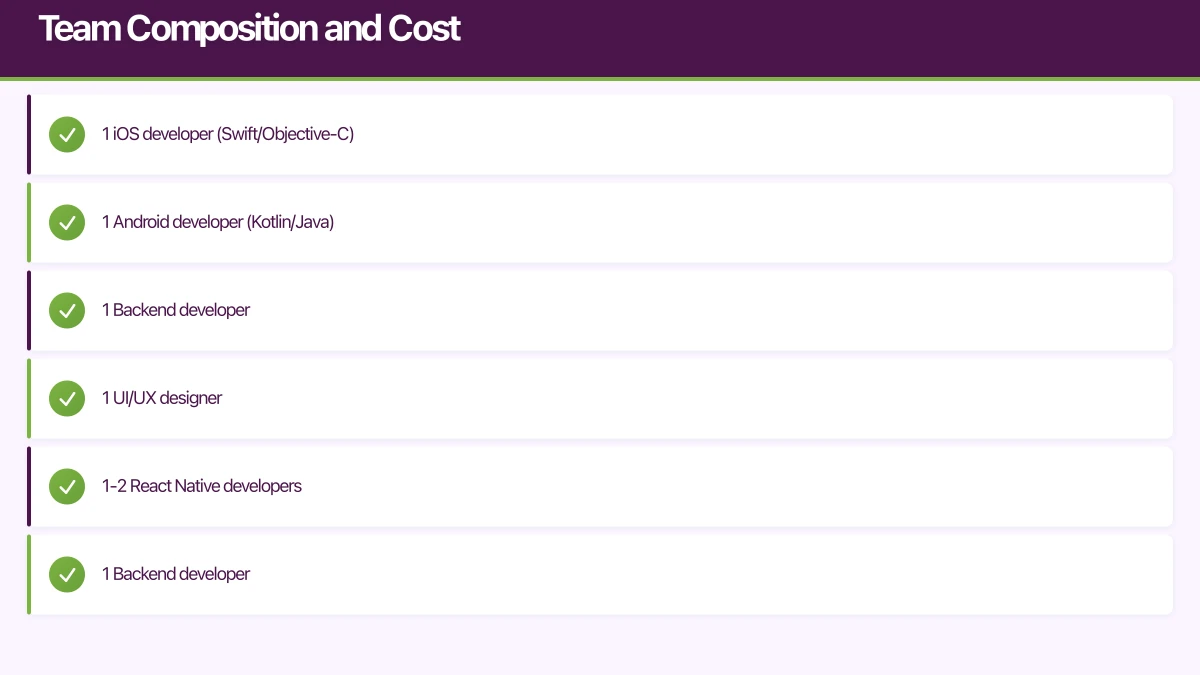
Native Development Team
Building native iOS and Android apps requires separate specialists:
Minimum viable team:
- 1 iOS developer (Swift/Objective-C)
- 1 Android developer (Kotlin/Java)
- 1 Backend developer
- 1 UI/UX designer
Total: 4 people
In the Australian market (September 2022), senior mobile developer salaries range from $130,000 to $170,000 AUD per year. Contract rates for experienced developers sit between $150 and $220 per hour.
For an agency engagement, native development for both platforms typically runs between $200,000 and $500,000 AUD for a medium-complexity app, depending on features and timeline.
React Native Team
A React Native team can be smaller because one developer writes code for both platforms:
Minimum viable team:
- 1-2 React Native developers
- 1 Backend developer
- 1 UI/UX designer
Total: 3-4 people
React Native developers command similar rates to native developers. The savings come from needing fewer of them, not from cheaper labour.
For an agency engagement, React Native development typically runs between $130,000 and $350,000 AUD for a medium-complexity app.
Cost Comparison: Team
| Factor | Native (iOS + Android) | React Native |
|---|---|---|
| Developers needed | 2-3 | 1-2 |
| Specialisation | Platform-specific | JavaScript/React |
| Annual team cost | $390K-$510K | $260K-$340K |
| Agency project cost | $200K-$500K | $130K-$350K |
Approximate saving with React Native: 25% to 40% on initial development.
Development Timel
 ine
ine
Native Development Timeline
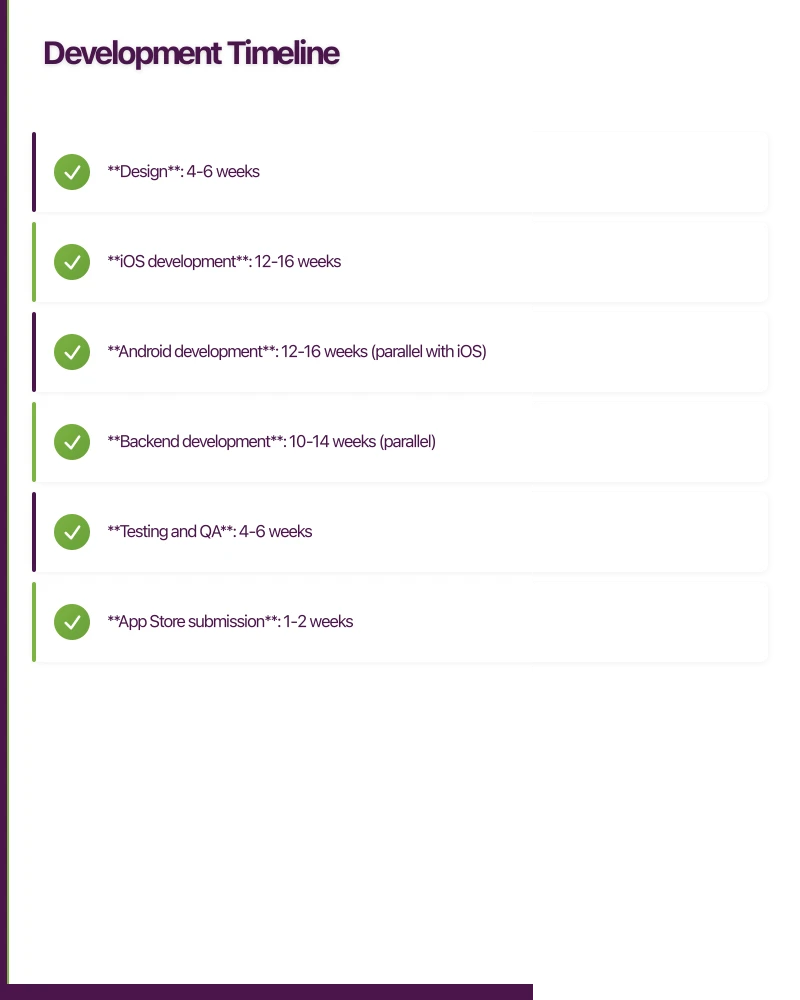
Native teams build each platform in parallel (or sequentially if budget-constrained). A medium-complexity app typically takes:
- Design: 4-6 weeks
- iOS development: 12-16 weeks
- Android development: 12-16 weeks (parallel with iOS)
- Backend development: 10-14 weeks (parallel)
- Testing and QA: 4-6 weeks
- App Store submission: 1-2 weeks
Total (parallel): 20-28 weeks Total (sequential): 32-44 weeks
React Native Timeline
With shared code, the development phase is compressed:
- Design: 4-6 weeks
- React Native development: 12-18 weeks (both platforms)
- Backend development: 10-14 weeks (parallel)
- Platform-specific work: 2-4 weeks
- Testing and QA: 4-6 weeks
- App Store submission: 1-2 weeks
Total: 18-26 weeks
React Native saves approximately 15 to 30 percent on timeline compared to parallel native development, and significantly more compared to sequential development.
Time-to-Market Value
For startups and new products, the timeline saving is often more valuable than the cost saving. Launching 6 to 8 weeks earlier means:
- Earlier revenue generation
- Earlier user feedback
- Earlier product-market fit validation
- Competitive advantage
If your product generates $50,000 per month at maturity, launching two months earlier is worth $100,000 in revenue alone.
Code Sharing Realit
y
The promise of React Native is shared code across platforms. In practice, the sharing ratio depends on the app’s complexity:
- Business logic and API calls: 90-100% shared
- UI components: 70-90% shared
- Navigation and routing: 85-95% shared
- Platform-specific features (camera, biometrics, native modules): 0-30% shared
- Overall typical sharing: 70-85%
This means 15 to 30 percent of your code is still platform-specific. Apps that rely heavily on native platform features (AR, advanced camera processing, low-level Bluetooth) see lower sharing ratios and diminished cost benefits.
Maintenance Co
 sts
sts
Initial development is only part of the story. Maintenance costs over the app’s lifetime often exceed the original build cost.
Native Maintenance
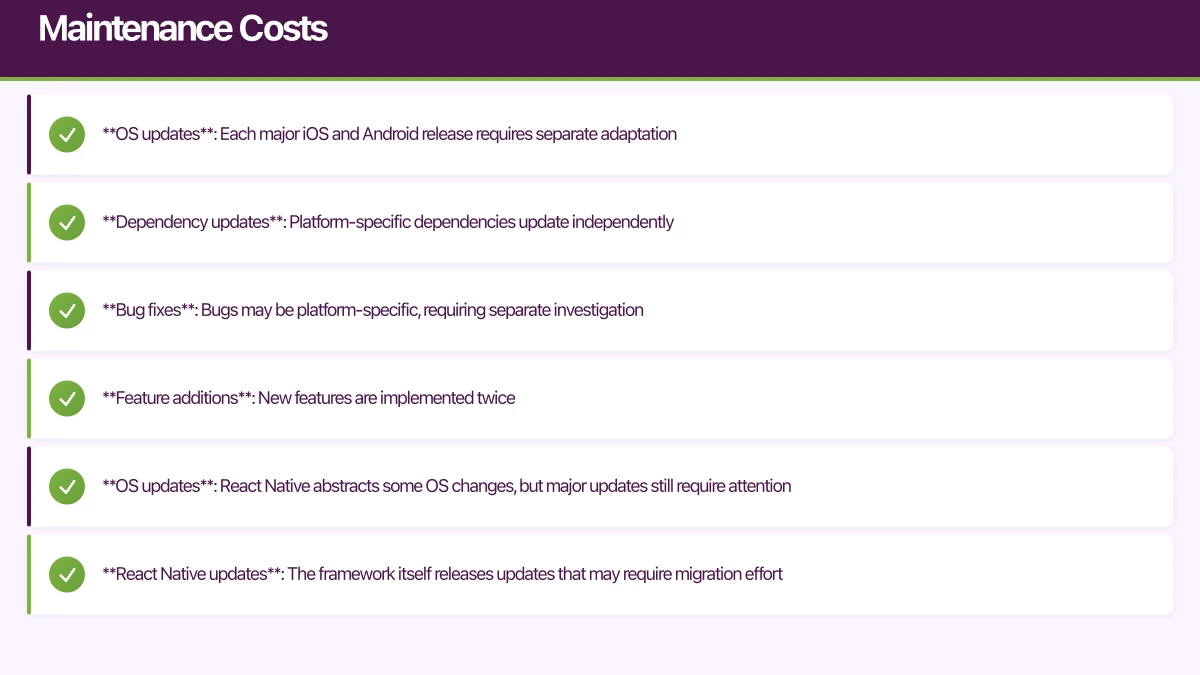
- OS updates: Each major iOS and Android release requires separate adaptation
- Dependency updates: Platform-specific dependencies update independently
- Bug fixes: Bugs may be platform-specific, requiring separate investigation
- Feature additions: New features are implemented twice
Typical annual maintenance: 20-25% of initial development cost per year
For a $400,000 native app: $80,000-$100,000 per year in maintenance.
React Native Maintenance
- OS updates: React Native abstracts some OS changes, but major updates still require attention
- React Native updates: The framework itself releases updates that may require migration effort
- Bridge overhead: Native module updates and bridge compatibility require ongoing attention
- Shared bug fixes: Most bugs are fixed once for both platforms
Typical annual maintenance: 15-20% of initial development cost per year
For a $250,000 React Native app: $37,500-$50,000 per year in maintenance.
Five-Year Total Cost of Ownership
| Year | Native (iOS + Android) | React Native |
|---|---|---|
| Year 0 (build) | $400,000 | $250,000 |
| Year 1 maintenance | $90,000 | $45,000 |
| Year 2 maintenance | $90,000 | $45,000 |
| Year 3 maintenance | $90,000 | $45,000 |
| Year 4 maintenance | $90,000 | $45,000 |
| 5-year total | $760,000 | $430,000 |
These are estimates for a medium-complexity app. Your actual costs will vary based on feature complexity, team composition, and geographic location.
Performance Comparison
Performance is a legitimate concern with React Native. The JavaScript bridge adds overhead compared to native code. In practice:
Where React Native performs well:
- Business applications (forms, lists, data display)
- Content consumption apps
- E-commerce apps
- Social applications
- Standard UI interactions
Where native wins meaningfully:
- Graphics-intensive applications (games, AR)
- Real-time audio/video processing
- Complex animations at 60fps
- Apps with heavy computation
- Hardware-intensive features
For the majority of business and consumer apps, React Native’s performance is indistinguishable from native. Users cannot tell the difference between a well-built React Native app and a native app. The apps where native performance matters are a minority, but they are often the apps where performance is the product.
Talent Availability
Australian Market (2022)
Finding experienced mobile developers in Australia is challenging regardless of your technology choice.
React Native developers: The JavaScript ecosystem is larger, and React Native draws from the web development talent pool. Finding developers is somewhat easier, though experienced React Native specialists are still in demand.
Native iOS developers (Swift): In moderate supply. Apple’s ecosystem attracts dedicated developers.
Native Android developers (Kotlin): Slightly harder to find in Australia. The Android developer pool is smaller in our market compared to iOS.
Recommendation: For Australian teams, React Native’s access to the JavaScript talent pool can be an advantage for hiring.
When to Choose Native
Native development is the right choice when:
- Performance is the product: Games, AR applications, video processing tools
- Deep platform integration needed: Apps that use the latest platform-specific APIs immediately after release (e.g., new iOS features on day one)
- Long-term product with dedicated teams: If you will have separate iOS and Android teams anyway, the code sharing benefit diminishes
- Existing native codebase: Migrating a mature native app to React Native rarely makes financial sense
- Platform-specific UX is critical: Apps where feeling perfectly native on each platform is a core requirement
When to Choose React Native
React Native is the right choice when:
- Budget is constrained: The 25-40% cost saving is significant for startups and small businesses
- Speed to market matters: Launching weeks earlier can determine product success
- The team has JavaScript expertise: Leveraging existing skills reduces ramp-up time
- The app is business-focused: CRUD operations, data display, forms, and standard UI patterns
- You need to support both platforms: Building for only one platform makes React Native less compelling
- The app will iterate rapidly: Shared code means faster iteration cycles
The Hybrid Approach
Some teams use a hybrid approach: React Native for most of the app with native modules for performance-critical features. This works well in practice:
- Core app screens and business logic in React Native (shared)
- Camera, AR, or computation-heavy features in native Swift/Kotlin
- React Native’s bridge connects the two cleanly
This approach captures most of the cost savings while avoiding performance compromises where they matter.
Making the Decision
Use this framework:
- List your app’s features
- Identify performance-critical features (if any)
- Estimate team cost for both approaches
- Calculate five-year TCO including maintenance
- Assess your timeline pressure
- Evaluate your available talent
For most Australian startups building their first mobile app in 2022, React Native offers the best balance of cost, speed, and quality. The savings fund additional features, marketing, or runway. For apps where performance is the differentiator or where you already have native teams, investing in native development pays for itself in user experience.
Conclusion
The cost difference between React Native and native development is real and meaningful: 25 to 40 percent on initial development and a similar ratio on ongoing maintenance. For a five-year period, this translates to hundreds of thousands of dollars for a medium-complexity app.
But cost is not the only factor. Consider your product’s specific requirements, your team’s expertise, your timeline pressure, and your long-term technical strategy. The cheapest option that does not meet your quality requirements is not actually cheap.
For help deciding on the right approach for your mobile app and getting an accurate cost estimate, contact eawesome. We build apps with both React Native and native technologies and can recommend the best fit for your specific situation.
Drive more app downloads with a professional web presence. Cosmos Web Tech specialises in web design and SEO for Australian tech businesses.
Awesome Apps is the mobile development division of Ganda Tech Services, building iOS and Android apps for Australian businesses.
Talk to a Sydney app developer — free.
30 minutes. We'll tell you what your app needs, how long it takes, and what it costs. Real answers, no sales pitch.
Book Free App Strategy Call →Free · 30 minutes · No obligation