According to a 2025 Deloitte Digital survey, 73% of Australian consumers say they’d engage more with a brand that made loyalty genuinely fun rather than transactional. Yet most Australian SMB loyalty programmes are still a paper stamp card or a points system nobody checks.
Daily quiz and trivia apps represent a different model: engagement that’s intrinsically rewarding, not just transactionally rewarding. Users come back every day because they want to, not because they’re chasing a discount.
We recently completed CineLadder — a daily Indian cinema quiz app with weekly promote/relegate leagues, cross-decade content, and personalised content slices for Tamil, Hindi, and Telugu cinema. The engagement mechanics we built into CineLadder are directly transferable to how Australian businesses can build loyalty apps that actually get opened every day.
Why Daily Is the Magic Word
Most loyalty apps get opened twice: the day you download them, and the day you delete them.
The ones that survive are built around a daily loop — a single action the user completes each day that takes 2-5 minutes and produces a satisfying outcome. The outcome can be:
- A score (quiz)
- A streak milestone (habit)
- A league position change (competition)
- A reward unlock (points / discount)
CineLadder uses all four. Users answer a 4-layer daily film quiz, earn XP, maintain a daily streak, and compete in a weekly league of ~30 users where the top performers promote to a higher division.
The result: daily active users who open the app before they check Instagram. That’s the retention benchmark every engagement app should target.
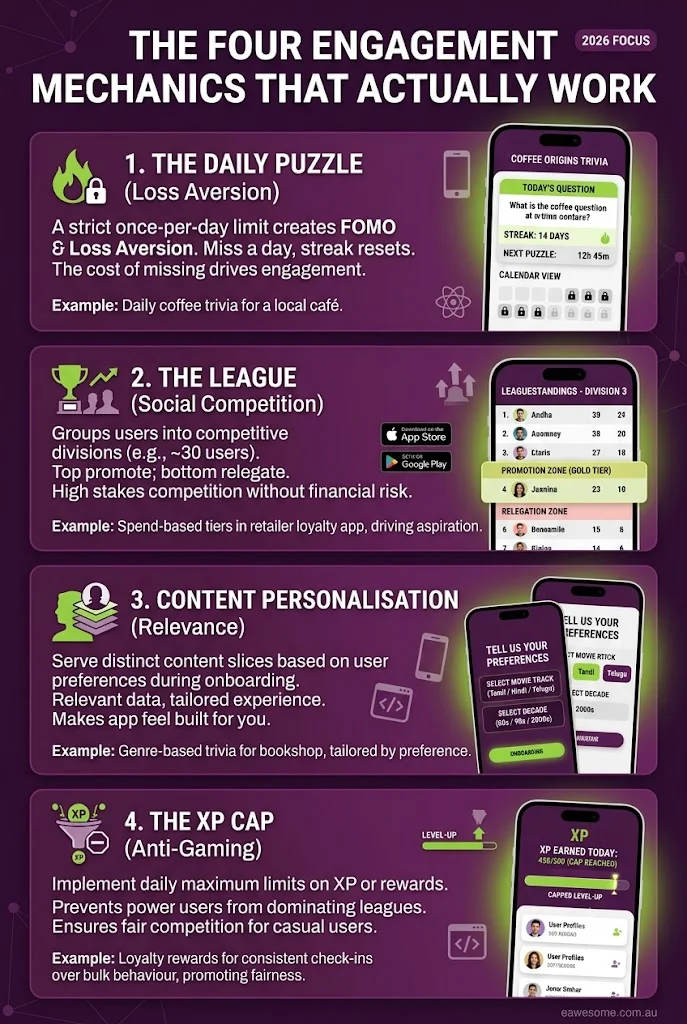
The Four Engagement Mechanics That Actually Work
1. The Daily Puzzle (Loss Aversion)
A quiz with a strict once-per-day limit creates loss aversion. Miss today’s puzzle, and your streak resets. This is the same mechanic that makes Wordle so sticky — not the puzzle itself, but the cost of missing it.
For an Australian café, this might be: one daily trivia question about coffee origins. For a bottle shop, a daily wine tasting note quiz. For a sports bar, a daily stats question about last night’s match. For a gym, a daily nutrition or anatomy question.
The content doesn’t have to be hard. It has to be yours, and it has to be daily.
2. The League (Social Competition)
CineLadder groups users into leagues of ~30 people. At the end of each week, the top performers promote to a more competitive division; the bottom performers relegate. This is borrowed from football’s promotion/relegation system — and it works because it creates meaningful stakes without real money.
For a business context: a retailer’s loyalty app could group customers into leagues based on monthly spend, with the top spenders promoting to a “Gold” tier with real benefits. The competition mechanic drives the spending; the tier drives the aspiration.
3. Content Personalisation (Relevance)
CineLadder’s most technically interesting feature is its slice architecture: rather than serving all users the same content, users select their preferred cinema track (Tamil / Hindi / Telugu) and decade (80s / 90s / 2000s) during onboarding. Only the relevant content slices download to their device.
For a business: a craft beer bar’s quiz app could serve different daily questions to users who said they prefer IPAs vs. lagers vs. sours. A bookshop app could serve literary trivia based on the user’s preferred genre. Personalisation is the difference between an app that feels like a product built for you and one that feels like a generic app with your logo on it.
4. The XP Cap (Anti-Gaming)
CineLadder implements an XP farming cap — users can only earn a maximum daily XP regardless of how many times they answer questions. This prevents power users from dominating leagues by grinding, making the competition fair for casual users.
For a business app: a similar mechanism ensures your loyalty programme rewards consistent engagement over bulk behaviour. A customer who checks in every day for a month shouldn’t be disadvantaged compared to someone who makes ten purchases in one day.
Real Business Use Cases We’re Building or Have Been Asked About
Hospitality: The Pub Quiz App
A Sydney pub chain approached us about building a digital version of their weekly quiz night. The concept: a daily trivia question pushed as a notification at 6pm (perfect pre-drinks timing), tied to a weekly leaderboard displayed on screens at the venue on Wednesday nights.
The winning user gets a tab credit automatically applied via their venue loyalty card. The leaderboard drives foot traffic on quiz night because people want to see where they placed.
Build scope: 3-4 months, $30,000-$50,000. Integrates with venue POS for credit redemption.
Retail: The Product Knowledge Quiz
An Australian specialty coffee roaster asked us about a quiz app that educates their retail customers on coffee origins, processing methods, and tasting notes — tied to a loyalty programme where quiz completions unlock early access to limited releases.
The insight: customers who understand your product buy more of it, and more often. An education layer embedded in a loyalty app converts casual buyers into enthusiasts.
Build scope: 2-3 months, $20,000-$35,000. Integrates with Shopify for loyalty points.
Healthcare: The Patient Education App
A Western Sydney physiotherapy group wanted an app where patients answer daily questions about their condition, treatment, and recovery — reinforcing what they learned in session.
Patients who understand their treatment comply with it better. A quiz mechanic makes compliance feel like a game rather than homework. The data also surfaces which concepts patients consistently misunderstand, helping the practice improve their clinical communication.
Build scope: 3-4 months, $35,000-$55,000. OAIC health data compliance required.
Education: The Micro-Learning Platform
A Hills District tutoring centre wanted a daily quiz app for their students — 5 questions per day in the subject areas they’re preparing for (HSC Maths, English, Chemistry). The app tracks performance over time and surfaces weak areas for the tutor’s review.
This turns a tutoring business into a 7-day-a-week service without adding staff hours. The tutor reviews the data dashboard weekly and adjusts lesson plans accordingly.
Build scope: 3-5 months, $30,000-$60,000. Includes tutor admin dashboard.
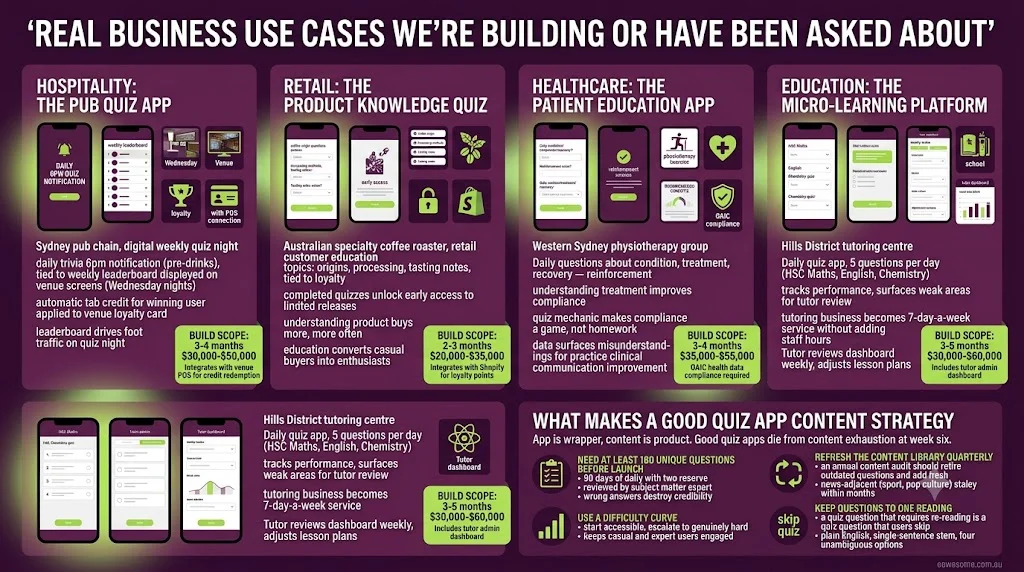
What Makes a Good Quiz App Content Strategy
The app is the wrapper. The content is the product. We’ve seen good quiz apps die from content exhaustion at week six. Here’s what we tell clients before they commission a build:
You need at least 180 unique questions before launch. That’s 90 days of daily questions with two questions in reserve. Questions should be reviewed by a subject matter expert — wrong answers or poorly worded questions destroy credibility instantly.
Questions should have a difficulty curve. Start accessible (everyone can answer), escalate to genuinely hard (only enthusiasts know this). The difficulty curve keeps both casual and expert users engaged.
Refresh the content library quarterly. An annual content audit should retire outdated questions and add fresh ones. For news-adjacent topics (sport, pop culture), questions become stale within months.
Keep questions to one reading. A quiz question that requires re-reading is a quiz question that users skip. Plain English, single-sentence stem, four unambiguous options.
The Architecture Behind a Daily Quiz App
When you’re evaluating developer quotes, here’s the component checklist:
| Component | Purpose | Cost signal |
|---|---|---|
| React Native app | iOS + Android cross-platform | Standard; Expo preferred |
| Content slice system | Personalised content delivery | +1-2 weeks for segmentation logic |
| Daily puzzle engine | Deterministic question selection | Timezone-aware; non-trivial |
| XP + streak engine | Engagement reward system | 1 week; include cap logic |
| League system | Weekly cohort competition | 2-3 weeks; include rollover cron |
| Push notifications | Daily reminder at optimal time | 1 week; APNs + FCM setup |
| Admin content portal | Add/edit/retire questions | 2-4 weeks; often underscoped |
| Analytics dashboard | DAU, streak rates, question difficulty | 1-2 weeks; PostHog recommended |
| Backend API | Cloudflare Workers or Node | Included in standard quote |
| App Store submission | Both stores | Allow 2 weeks per store |
The admin content portal is the most commonly underscoped item. Every quiz app needs a non-technical way for someone in your team to add new questions. If your developer doesn’t include this in scope, add it — otherwise you’ll be filing tickets every time you want to update content.
Cost and Timeline Summary for Australian Businesses
| App type | Timeline | Cost (AUD) |
|---|---|---|
| Simple daily quiz, single content track | 10-14 weeks | $22,000-$35,000 |
| Personalised quiz with league system | 14-20 weeks | $35,000-$60,000 |
| Full loyalty quiz platform with POS integration | 20-28 weeks | $60,000-$100,000 |
| Patient/student education platform with dashboard | 16-24 weeks | $45,000-$85,000 |
All figures include iOS + Android, backend API, App Store submission, and 3 months post-launch support. Australian GST applies.
For secure cloud infrastructure to host your quiz app’s backend and content delivery — Cloud Geeks provisions Cloudflare Workers and managed hosting for Australian SMB app backends.
Ash Ganda writes about how Australian businesses are using gamification and engagement mechanics to build defensible customer relationships in the age of AI.
Part of the Ganda Tech Services family, Awesome Apps builds iOS and Android applications for Australian small and medium businesses.
Frequently Asked Questions
How much does it cost to build a quiz or trivia loyalty app in Australia? A focused daily quiz app with a streak and leaderboard system costs $22,000-$60,000 AUD depending on the complexity of the personalisation layer, league system, and integrations with your existing loyalty or POS system. Full loyalty platforms with POS integration sit at $60,000-$100,000.
Can I use existing quiz platforms instead of building custom? Platforms like Kahoot, QuizUp, or Typeform Quizzes exist, but they’re generic tools — your brand is secondary to theirs, you don’t own the user data, and you can’t integrate with your POS, loyalty programme, or CRM. Custom is the right call when the quiz is a core part of your product or loyalty strategy, not a one-off activation.
How do I keep users coming back after the novelty wears off? The league system is the most effective retention mechanic we’ve implemented. Once users are invested in their league position, they keep playing to protect their rank. Combine this with fresh weekly question sets and rotating content themes to sustain the novelty.
What’s the minimum content I need before launching? We recommend at least 180 unique questions covering 90 days of play with backup content in reserve. Questions should be reviewed by a subject matter expert before launch. Budget 2-4 weeks for content preparation alongside the technical build.
Does a quiz app need to integrate with my existing loyalty system? Not necessarily. A standalone quiz app with its own points system is a valid starting point. Integration with your existing POS or loyalty platform (Lightspeed, Shopify, Vend) adds 4-8 weeks to the build and $8,000-$20,000 to the budget. Many clients start standalone and integrate in version 2 once they have proven engagement.
Talk to a Sydney app developer — free.
30 minutes. We'll tell you what your app needs, how long it takes, and what it costs. Real answers, no sales pitch.
Book Free App Strategy Call →Free · 30 minutes · No obligation