Australian gyms lose an average of 50% of new members within the first 90 days. Allied health practices see 40% of clients drop off before their recommended treatment plan is complete. Mindfulness coaches lose subscribers as soon as the novelty fades.
The common thread: there’s no daily touchpoint keeping the client connected to the service between sessions.
A well-built daily habit app with an iOS home-screen widget changes that equation. We recently completed development of Wisdom Booth — a daily wisdom and habit app (App Store ID: 6785022790), building both the React Native mobile app and the WidgetKit-powered iOS home-screen widget that displays a quote or prompt every morning. What we learned building it is directly applicable to any Australian wellness or coaching business considering a similar product.
What a Daily Habit App Actually Is
A daily habit app is not a general-purpose wellness platform. It’s a focused product built around one core loop:
Open the app once a day -> complete a micro-ritual -> get a reward signal -> streak preserved.
The ritual can be:
- A guided breathing exercise (meditation studio)
- A quote reflection with a journaling prompt (mindfulness coach)
- A daily check-in with mood or pain level tracking (physio, psychologist)
- A micro-workout or mobility drill (gym, PT)
- A daily affirmation tied to a coaching programme (life coach, business coach)
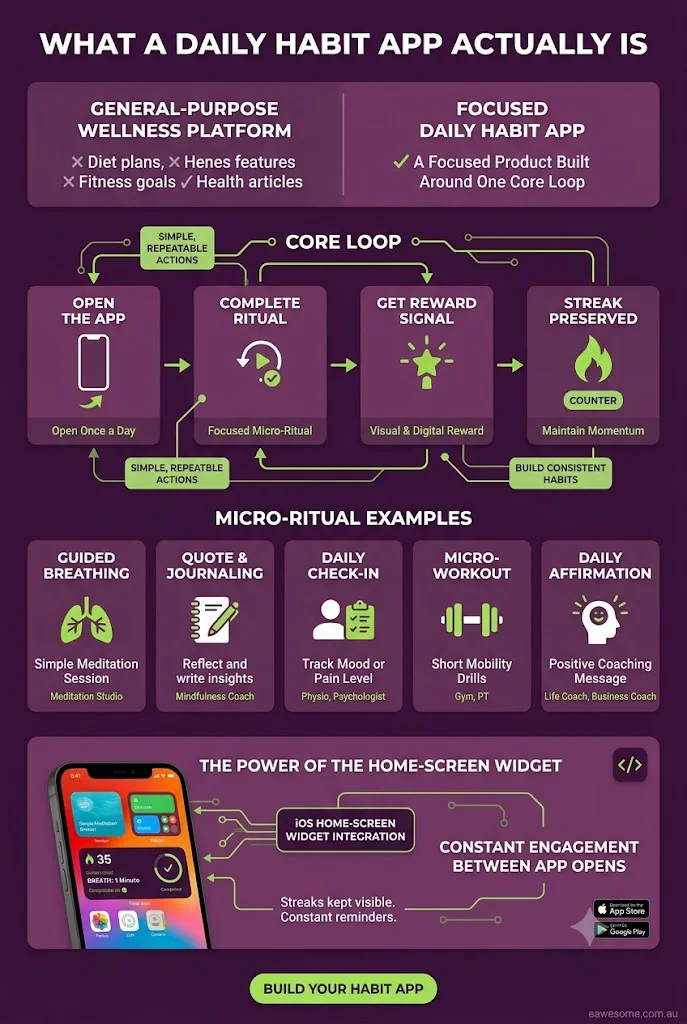
What makes the category powerful is what happens between app opens: the iOS home-screen widget.
Why the Widget Is the Real Retention Driver
When we built Wisdom, the most important engineering decision wasn’t the content — it was the widget integration. Here’s why this matters for your business:
The widget puts your brand on the client’s home screen permanently.
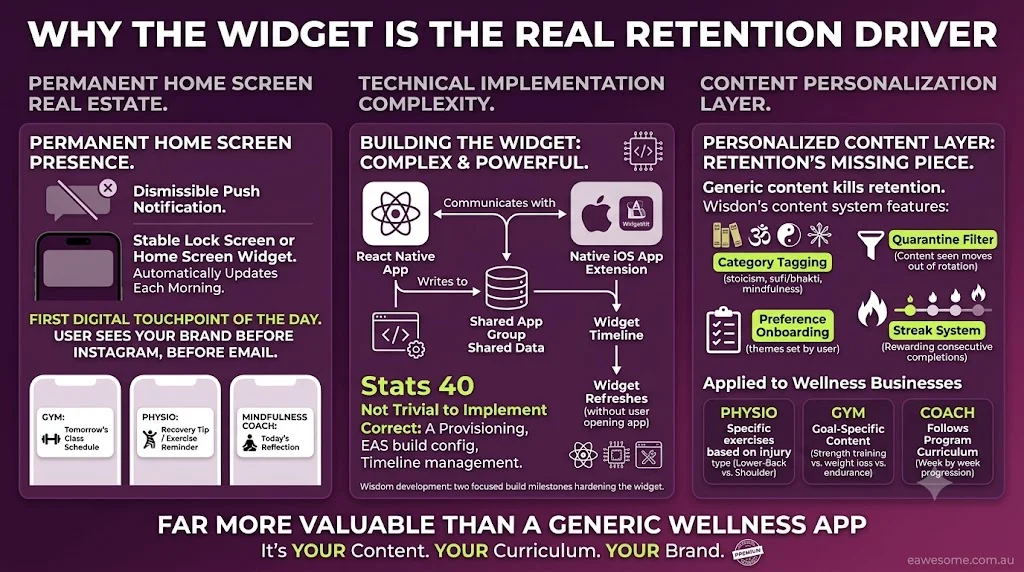
Unlike a push notification (which gets dismissed), a widget sits passively on the lock screen or home screen, updating automatically each morning. The user sees your brand before they open Instagram. Before they open email. The first digital touchpoint of their day.
For a gym, that widget might show tomorrow’s class schedule. For a physio, it shows a recovery tip or their exercise reminder. For a mindfulness coach, it shows today’s reflection.
The technical implementation uses Apple’s WidgetKit framework, which requires React Native to communicate with a native iOS App Extension via a shared App Group — a sandboxed data container both the main app and the widget can read. When the app updates (say, the user completes their daily ritual), it writes to the App Group and triggers a widget timeline reload. The widget refreshes without the user having to open the app.
This architecture is not trivial to implement correctly — App Group provisioning, EAS (Expo Application Services) build configuration, and widget timeline management all have sharp edges. We spent two focused build milestones hardening the Wisdom widget before it passed App Store submission.
The Content Personalisation Layer
The second major technical component of a successful daily habit app is personalised content delivery.
Showing the same quote to every user kills retention. Users need to feel the app “knows” them. We built Wisdom’s content system with:
- Category tagging on every piece of content (e.g., Sufi/Bhakti wisdom, stoicism, modern mindfulness)
- A quarantine filter that moves content a user has seen out of rotation
- Preference-based surfacing set during onboarding — the user picks their preferred tradition or theme
- A streak system that rewards consecutive daily completions with visual milestones
For a wellness business, the personalisation layer translates to: a physio whose app serves different exercises based on whether the client has a lower-back or shoulder issue. A gym whose app serves content based on whether the member trains for strength, weight loss, or endurance. A coach whose app follows the client’s programme curriculum week by week.
This is far more valuable than a generic wellness app from the App Store. It’s your content, your curriculum, your brand.
What Australian Wellness Businesses Are Actually Building
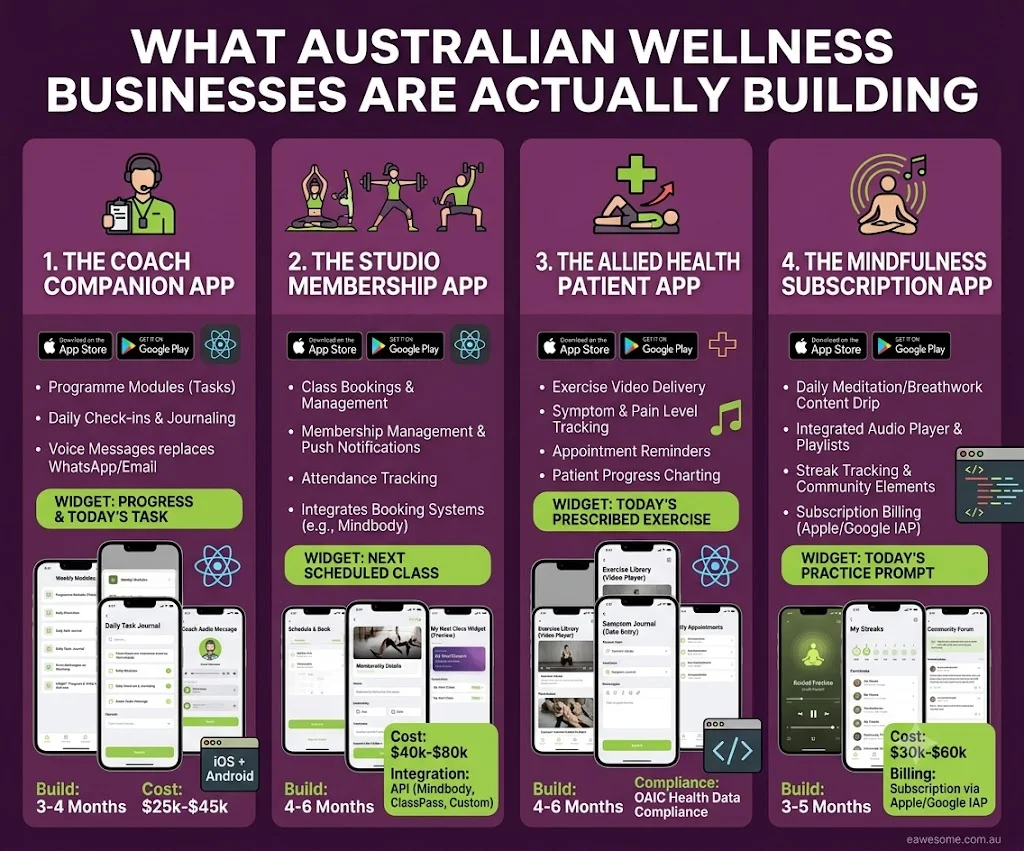
We’re seeing four distinct product shapes emerge from Australian wellness businesses:
1. The Coach Companion App
Built for one-to-one coaching practices (life coaches, business coaches, PT). The app delivers the coach’s programme content — weekly modules, daily check-ins, journalling prompts, voice messages. Replaces WhatsApp or email for programme delivery. The widget shows the client’s progress and today’s task.
Typical scope: 3-4 months build, $25,000-$45,000. iOS + Android.
2. The Studio Membership App
Built for yoga studios, gyms, Pilates studios. Features: class bookings, attendance tracking, membership management, push notifications for schedule changes. The widget shows the next scheduled class.
Typical scope: 4-6 months build, $40,000-$80,000. Integrates with booking system (Mindbody, ClassPass API, custom).
3. The Allied Health Patient App
Built for physios, chiropractors, psychologists. Features: exercise video delivery, symptom tracking, appointment reminders, progress charting. The widget shows today’s prescribed exercise.
Typical scope: 4-6 months build, $45,000-$90,000. OAIC compliance required for any health data storage.
4. The Mindfulness Subscription App
Built for meditation teachers, breathwork coaches, spiritual practices. Features: daily content drip, audio player, streak tracking, community elements. Monetised via subscription (App Store IAP). The widget shows today’s practice prompt.
Typical scope: 3-5 months build, $30,000-$60,000. Subscription billing via Apple/Google IAP.
Why Not Just Use an Off-the-Shelf App?
The question we hear most: “Can’t I just white-label an existing wellness app platform?”
Platforms like Trainerize, Mindbody, and Vagaro are excellent for what they do — but they solve generic problems. You get their brand UX, their limitations, their pricing, and their data ownership model.
A custom app gives you:
- Your brand on the client’s home screen (not Trainerize’s)
- Your content structure — not constrained by someone else’s template
- Your data — client engagement, streak data, content preferences — owned by you
- Your monetisation — set your own subscription pricing without paying a platform cut
- Integration with your existing tools — Xero for billing, your CRM, your booking system
The break-even point for custom vs. platform typically hits at 200-500 active monthly clients, depending on your platform fees. Below that, a platform makes economic sense. Above it, custom pays for itself within 12-18 months.
The Technical Architecture (What Your Developer Quote Should Include)
When you’re evaluating quotes for a daily habit app with a widget, these components should be in scope:
| Component | What it does | What to watch for |
|---|---|---|
| React Native app | Cross-platform iOS + Android | Should use Expo SDK 50+ for WidgetKit support |
| WidgetKit extension | iOS home-screen widget | Requires App Group + EAS build config |
| App Group bridge | Widget ↔ app data sync | Often undiscoped — add a sprint for this |
| Content management | Tagging, quarantine filter, personalisation | CMS or admin panel needed |
| Streak engine | Daily completion tracking | Timezone handling is tricky — specify AU timezones |
| Push notifications | Re-engagement for lapsed users | APNs setup + Expo Notifications |
| Backend API | Content delivery + user data | Cloudflare Workers or Node/Express |
| App Store submission | Apple + Google review | Build 2 weeks lead time; first-submission pass rate ~70% |
Android does not have WidgetKit — it uses Jetpack Glance (a different system). If you want Android widgets, budget an extra 2-3 weeks of native development or specify iOS-only for your first release.
What We Recommend for First-Time App Owners in Australia
If you’re a wellness business owner building your first app:
Start with iOS only. Roughly 55% of Australian smartphone users are on iOS (higher in urban professional demographics). A single-platform first release halves your build cost and gets you to market 6-8 weeks faster. Android can follow once you have proven retention metrics.
Don’t skip the widget. Our data from Wisdom shows that users who add the widget to their home screen have a 3x higher 30-day retention rate than users who don’t. The widget integration is worth the extra 2-3 weeks of build time.
Design the content before you build the app. The app is a delivery vehicle. The content — your daily rituals, your exercises, your wisdom — is the product. Wellness apps fail when the content runs out at week 4. Have at least 90 days of unique content ready before launch.
Budget for the App Store review cycle. Apple reviews typically take 24-48 hours but can stretch to 7 days if there’s a question about health claims. Apps that reference health outcomes (weight loss, pain reduction, mental health benefits) require careful metadata that doesn’t trigger medical claims review. We’ve navigated this many times; factor it into your timeline.
For OAIC-compliant health data hosting, data sovereignty, and secure cloud infrastructure for patient-facing apps — Cloud Geeks provides managed cloud infrastructure for Australian healthcare and wellness businesses, with onshore data storage.
Ash Ganda covers how Australian wellness businesses are using AI-powered personalisation and automation to deliver better client outcomes at scale.
Part of the Ganda Tech Services family, Awesome Apps builds iOS and Android applications for Australian small and medium businesses.
Frequently Asked Questions
How much does it cost to build a daily habit app with an iOS widget in Australia? A focused daily habit app with a home-screen widget typically costs $25,000-$60,000 AUD depending on the content complexity, personalisation logic, and integrations required. A simple single-category app sits at the lower end; a full studio membership app with booking integrations is at the upper end. All quotes should include App Store submission.
How long does it take to build a wellness app? For a focused daily habit app (iOS only), expect 10-16 weeks from strategy call to App Store approval. Adding Android extends this by 6-8 weeks. Complex integrations with booking systems or health records add further time.
Does my app need to comply with Australian health data laws? If your app collects health data (symptoms, diagnoses, exercise records, mental health notes), it falls under the Privacy Act 1988 and potentially the My Health Records Act. For allied health practices, consult your professional association guidelines before designing the data model. We work with a legal partner who specialises in Australian health app compliance.
Can I build this app with React Native instead of native Swift/Kotlin? Yes. React Native (with Expo SDK 52+) supports WidgetKit on iOS via native modules. The widget itself is written in Swift (it has to be — Apple requires it), but the bridge to React Native and the main app logic can be cross-platform. This is exactly the architecture we used for Wisdom.
What happens after the app launches — do I need ongoing support? Yes. iOS and Android release OS updates 1-2 times per year that break API compatibility. App Store review policies change. Your content needs to grow. Budget $1,500-$3,000/month for ongoing maintenance, content updates, and compatibility patches after launch.
Talk to a Sydney app developer — free.
30 minutes. We'll tell you what your app needs, how long it takes, and what it costs. Real answers, no sales pitch.
Book Free App Strategy Call →Free · 30 minutes · No obligation