Introduction
“How much does an app cost?” is the first question every startup founder asks. The honest answer is frustrating: it depends. But that doesn’t help you plan a budget or pitch to investors.
After building apps for Australian startups across healthtech, fintech, logistics, and marketplace sectors, we’ve developed reliable cost ranges. This guide breaks down what you’ll actually spend in 2025, where those costs come from, and how to stretch your budget further.
The Quick Numbers
Here’s what mobile app development typically costs in Australia in 2025:
| App Complexity | Timeline | Cost Range (AUD) |
|---|---|---|
| Simple MVP | 2-3 months | $40,000 - $80,000 |
| Medium complexity | 4-6 months | $80,000 - $180,000 |
| Complex/feature-rich | 6-12 months | $180,000 - $400,000+ |
These ranges assume an Australian development team. Offshore teams cost 40-60% less, but we’ll discuss the tradeoffs later.
What Drives App Development Costs
1. Platform Choice
iOS only or Android only: Base cost Both platforms (native): 1.7-1.9x the single platform cost Cross-platform (React Native/Flutter): 1.2-1.4x single platform cost
Cross-platform frameworks have matured significantly. For most apps, React Native or Flutter delivers 80-90% of native performance at significantly lower cost. The exceptions:
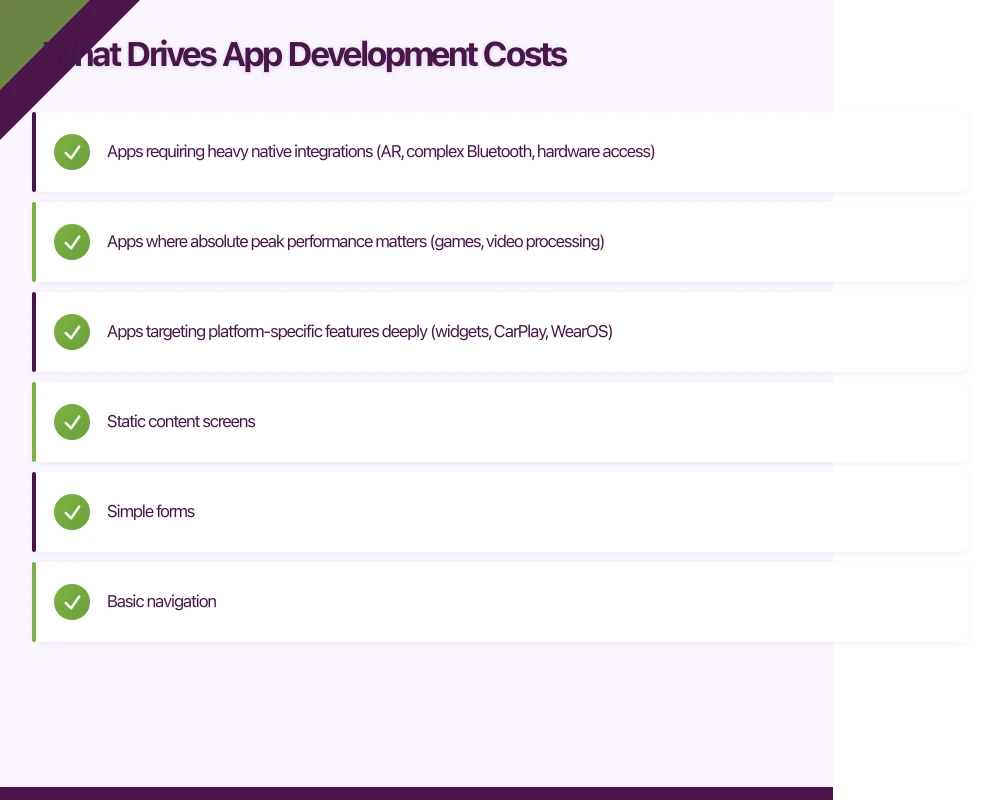
- Apps requiring heavy native integrations (AR, complex Bluetooth, hardware access)
- Apps where absolute peak performance matters (games, video processing)
- Apps targeting platform-specific features deeply (widgets, CarPlay, WearOS)
2. Feature Complexity
Features aren’t created equal. Here’s what different capabilities cost:
Low complexity ($2,000-$5,000 per feature):
- Static content screens
- Simple forms
- Basic navigation
- Standard UI components
Medium complexity ($5,000-$15,000 per feature):
- User authentication (social login, email/password)
- Push notifications
- In-app purchases
- Basic maps integration
- Image upload and display
- Search functionality
High complexity ($15,000-$40,000+ per feature):
- Real-time chat/messaging
- Payment processing
- Complex maps (custom markers, routing, geofencing)
- Video streaming
- Offline sync with conflict resolution
- AI/ML features (recommendations, image recognition)
- Third-party integrations (depending on API quality)
3. Design Requirements
| Design Level | What You Get | Cost (AUD) |
|---|---|---|
| Basic | Standard components, minimal customisation | $5,000-$10,000 |
| Custom | Branded UI, custom components, animations | $15,000-$30,000 |
| Premium | Full UX research, prototyping, micro-interactions | $30,000-$60,000 |
Skimping on design is tempting but often false economy. Poor UX leads to poor retention, which means your development investment doesn’t pay off.
4. Backend Requirements
Your app needs somewhere to store data and run logic. Backend costs depend on:
No backend needed ($0):
- Purely local apps (calculators, note-taking)
- Apps using only third-party services (Firebase, Supabase)
Simple backend ($15,000-$30,000):
- User accounts
- Basic data storage
- Simple API endpoints
- Standard hosting
Complex backend ($40,000-$100,000+):
- Real-time features
- Complex business logic
- Integrations with existing systems
- High-availability requirements
- Compliance requirements (health data, financial data)
5. Team Composition
Different team structures have different costs:
Freelancers: $80-$150/hour
- Lower overhead
- Less coordination
- Variable availability
- You manage the project
Local agency: $150-$220/hour
- Established processes
- Dedicated project management
- Multiple skill sets available
- Higher overhead costs
In-house team: Salary + 30% overhead
- Senior mobile developer: $140,000-$180,000/year
- Mid-level developer: $100,000-$140,000/year
- Junior developer: $70,000-$100,000/year
- Plus: workspace, equipment, benefits, management time
For a startup, in-house rarely makes sense until you have ongoing development needs for 2+ years.
Sample Budgets for Real Sce
 narios
Scenario 1: Consumer MVP ($50,000-$70,000)
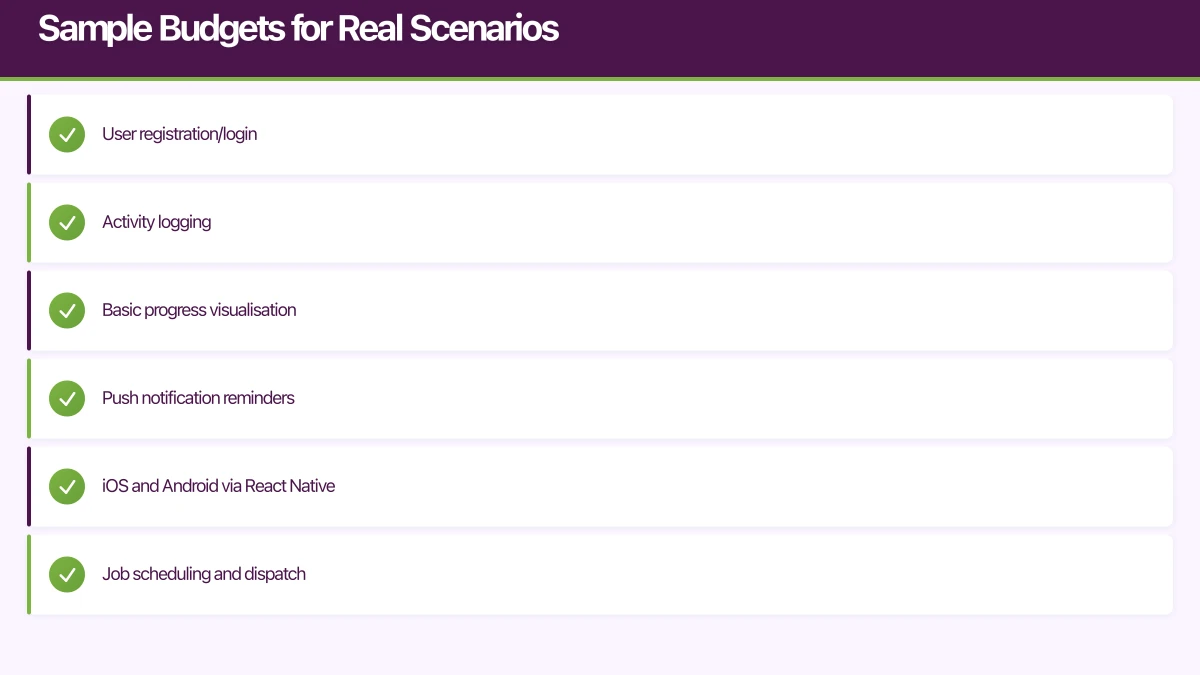
A fitness tracking app with:
- User registration/login
- Activity logging
- Basic progress visualisation
- Push notification reminders
- iOS and Android via React Native
Breakdown:
| Item | Cost |
|---|---|
| UX/UI Design | $8,000 |
| App Development (React Native) | $32,000 |
| Backend (Firebase) | $5,000 |
| Testing & QA | $5,000 |
| Project Management | $5,000 |
| App Store Submission | $2,000 |
| Total | $57,000 |
Timeline: 10-12 weeks
Scenario 2: B2B Field Service App ($120,000-$160,000)
A tradesperson management app with:
- Job scheduling and dispatch
- GPS tracking and routing
- Photo documentation
- Offline capability
- Customer portal
- Basic invoicing
- Integration with Xero
Breakdown:
| Item | Cost |
|---|---|
| Discovery & Planning | $8,000 |
| UX/UI Design | $18,000 |
| Mobile App (React Native) | $55,000 |
| Backend Development | $35,000 |
| Xero Integration | $12,000 |
| Testing & QA | $10,000 |
| Project Management | $10,000 |
| Documentation | $3,000 |
| Total | $151,000 |
Timeline: 16-20 weeks
Scenario 3: Healthcare Platform ($250,000-$350,000)
A telehealth app with:
- Patient registration with ID verification
- Video consultations
- Prescription management
- Payment processing (Medicare, private)
- Provider dashboard
- Secure messaging
- HIPAA/AHPRA compliance
- Integration with practice management systems
Breakdown:
| Item | Cost |
|---|---|
| Discovery & Compliance Review | $15,000 |
| UX/UI Design & Research | $35,000 |
| iOS App (native, for video quality) | $70,000 |
| Android App (native) | $55,000 |
| Backend Development | $60,000 |
| Payment Integration | $15,000 |
| Video Infrastructure | $20,000 |
| Security Audit | $12,000 |
| Testing & QA | $18,000 |
| Project Management | $18,000 |
| Total | $318,000 |
Timeline: 28-36 weeks
Hidden Costs Startups Miss
1. App Store Fees
- Apple Developer Program: $149/year
- Google Play Developer: $25 one-time
- Apple’s 30% commission on in-app purchases (15% for Small Business Program)
- Google’s 15% for first $1M, then 30%
2. Third-Party Services
Monthly operational costs that add up:
| Service | Typical Cost |
|---|---|
| Push notifications (OneSignal/Firebase) | $0-$100/month |
| Analytics (Mixpanel/Amplitude) | $0-$500/month |
| Crash reporting (Sentry/Crashlytics) | $0-$50/month |
| Cloud hosting (AWS/GCP) | $100-$2,000/month |
| Email service (SendGrid/SES) | $20-$200/month |
| Maps API (Google/Mapbox) | $0-$500/month |
| SMS verification (Twilio) | $50-$500/month |
Budget $500-$2,000/month for a typical app once it’s in production.
3. Ongoing Maintenance
Apps aren’t “done” when you launch. Budget for:
- Bug fixes: 5-10% of development cost annually
- OS updates: iOS and Android release major updates yearly; budget $5,000-$15,000 per platform per year
- Security patches: Ongoing as vulnerabilities are discovered
- Feature updates: Whatever your users demand
A reasonable maintenance budget is 15-25% of initial development cost per year.
4. Marketing & User Acquisition
Building the app is only half the battle. Typical customer acquisition costs:
- Consumer app: $2-$10 per install (iOS higher than Android)
- B2B app: $50-$200 per qualified lead
- App Store Optimisation (ASO): $2,000-$5,000 initial, $500-$1,000/month ongoing
5. Legal & Compliance
- Privacy policy and terms: $2,000-$5,000
- GDPR/Privacy Act compliance review: $3,000-$8,000
- Healthcare compliance (TGA, AHPRA): $10,000-$30,000
- Fintech compliance (ASIC, APRA): $20,000-$50,000
How to Reduce Costs Without Sacrificing Quality
1. Start with a True MVP
Define the smallest version that tests your core hypothesis. A landing page with waitlist might be enough before building anything.
[x] "We need AI-powered recommendations, social features,
    gamification, AR try-on, and a marketplace."

[x] "We need users to complete one core action that proves
    they'll pay for this solution."
2. Use Managed Services
Don’t build what you can buy:
- Authentication: Firebase Auth, Auth0, Clerk ($0-$500/month beats $20,000 to build)
- Payments: Stripe, Square (handles PCI compliance)
- Backend: Supabase, Firebase (instant backend for common patterns)
- Chat: Stream, SendBird (real-time messaging is hard to build well)
3. Consider No-Code/Low-Code for Internal Tools
If you need admin dashboards or internal tools, Retool, Bubble, or AppSheet can save tens of thousands compared to custom development.
4. Phase Your Development
Instead of building everything at once:
Phase 1 (MVP): Core feature only, 8-12 weeks, $40,000-$60,000 Phase 2: Based on user feedback, 6-8 weeks, $25,000-$40,000 Phase 3: Scale features, 8-12 weeks, $35,000-$60,000
This approach costs similar overall but reduces risk and lets you adjust based on real user data.
5. Offshore Strategically
Offshore development works when:
- Requirements are very clear and detailed
- You have technical expertise to review work
- Time zones overlap (Vietnam, Philippines)
- Communication is excellent
It fails when:
- Requirements are vague or evolving
- You need rapid iteration based on user feedback
- Complex domain knowledge is required
- You can’t dedicate time to managing the relationship
A hybrid approach—Australian design and product management with offshore development—can offer savings while maintaining quality.
Funding Your App
Bootstrapping
Most Australian startups self-fund their MVP:
- Personal savings
- Friends and family
- Revenue from consulting/services
- Part-time development while working
Typical bootstrap budget: $30,000-$80,000
Government Grants
Australia offers several relevant grants:
- R&D Tax Incentive: 43.5% refundable offset for eligible R&D
- Accelerating Commercialisation: Up to $1M for commercialisation activities
- State grants: NSW MVP Grant ($25,000), VIC Startup Funding ($500,000 loans)
Angel Investment
Pre-seed/seed rounds in Australia typically range $100,000-$500,000 for 10-20% equity. Angels expect:
- Working MVP or strong prototype
- Evidence of market demand
- Clear path to revenue
- Founder capability
Venture Capital
Series A in Australia typically starts at $2-5M. VCs expect:
- Proven product-market fit
- Revenue or strong growth metrics
- Large addressable market
- Scalable business model
Conclusion
Mobile app development in Australia costs $40,000-$400,000+ depending on complexity. The biggest variables are feature scope, platform choice, and team structure.
For startups, the smart approach is:
- Define the true MVP — what’s the minimum needed to test your hypothesis?
- Use managed services — don’t build commodity features
- Phase development — reduce risk by building incrementally
- Budget for the full journey — development is 50-60% of year-one costs
Get quotes from multiple teams, but be wary of outliers. If someone quotes $15,000 for what others quote $60,000, they either don’t understand the requirements or will deliver something that doesn’t meet them.
The cost of building the app is significant, but it’s often the cheapest lesson in determining whether your business idea works. Better to spend $60,000 learning than $600,000.
Launching an app? You’ll need a website to support it. Cosmos Web Tech builds app landing pages and marketing sites for Australian businesses.
Awesome Apps is the mobile development division of Ganda Tech Services, building iOS and Android apps for Australian businesses.
Talk to a Sydney app developer — free.
30 minutes. We'll tell you what your app needs, how long it takes, and what it costs. Real answers, no sales pitch.
Book Free App Strategy Call →Free · 30 minutes · No obligation