Introduction
Building a great app is one challenge. Making money from it is another. The App Store and Play Store are filled with quality apps that fail commercially—not because users don’t value them, but because the monetization strategy doesn’t fit the app or market.
This guide covers the major monetization models, when each works best, and how to implement them effectively.
The Monetization Landscape
Why Monetization Strategy Matters
The monetization model you choose affects:
- How you design the app
- What users expect
- How you acquire users
- Your long-term business sustainability
Getting this wrong is expensive. Changing monetization models after launch is difficult—users have expectations, and suddenly introducing paywalls or ads damages trust.
Key Metrics to Understand
ARPU (Average Revenue Per User) Total revenue divided by total users. Helps compare monetization efficiency.
ARPPU (Average Revenue Per Paying User) Revenue from paying users divided by number of paying users. Shows spending depth.
Conversion Rate Percentage of free users who become paying users. Typically 1-5% for freemium apps.
LTV (Lifetime Value) Total revenue expected from a user over their entire relationship with your app.
Payback Period How long until user acquisition cost is recovered through revenue.
Monetization Mo
 dels
dels
Freemium
Users download for free, pay to unlock premium features or content.
How It Works
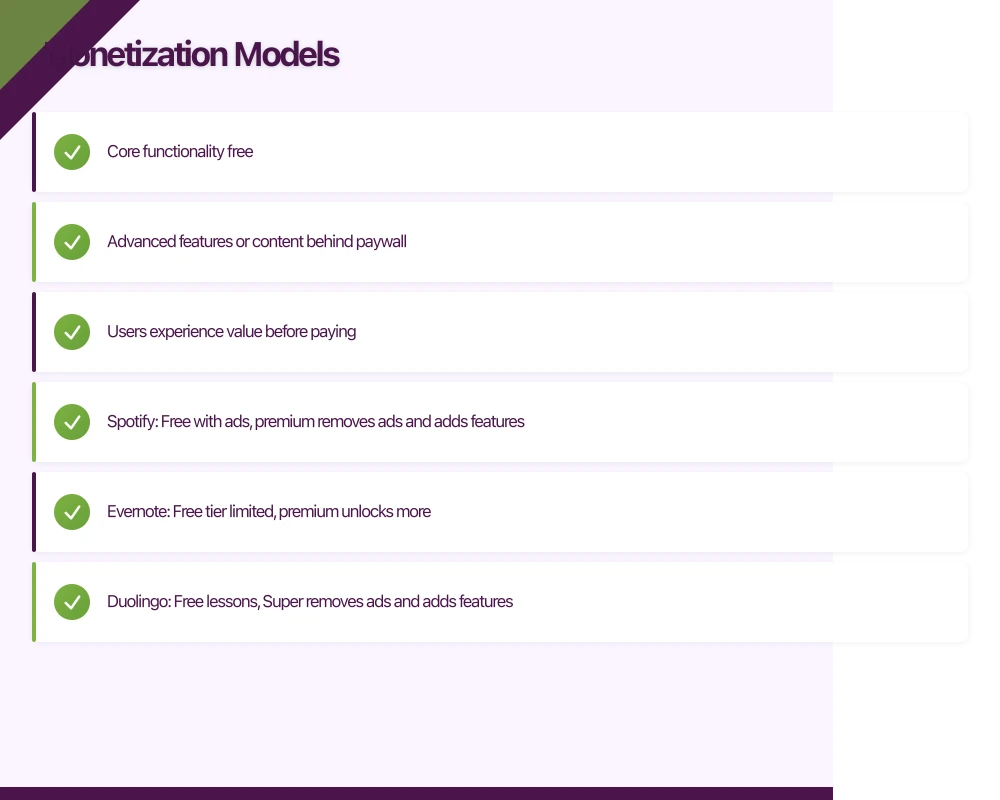
- Core functionality free
- Advanced features or content behind paywall
- Users experience value before paying
Examples
- Spotify: Free with ads, premium removes ads and adds features
- Evernote: Free tier limited, premium unlocks more
- Duolingo: Free lessons, Super removes ads and adds features
Pros
- Low barrier to entry drives downloads
- Users prove value to themselves
- Viral potential (free users can share)
- Conversion happens after engagement
Cons
- Most users never pay (95-99%)
- Must provide genuine value for free
- Constant tension between free and paid features
- Can feel manipulative if done poorly
Best For
- Apps with clear premium features
- Products where free tier still provides value
- Markets where paid apps don’t sell
- Apps benefiting from network effects
Implementation Tips
- Free tier must be genuinely useful (not crippled)
- Premium value must be obvious
- Upgrade prompts at moments of high intent
- Don’t annoy free users into leaving
Subscriptions
Recurring payments for ongoing access or service.
How It Works
- Monthly or annual recurring charges
- Usually with free trial period
- Often replaces one-time purchase
Examples
- Netflix: Monthly access to content library
- Headspace: Monthly meditation content
- Strava: Annual subscription for advanced features
Pricing Models
- Monthly only
- Annual only (higher commitment)
- Both with annual discount (common: 40-50% off monthly rate)
Pros
- Predictable recurring revenue
- Higher lifetime value
- Aligns incentives (must keep providing value)
- App Store/Play Store promote subscription apps
Cons
- Harder to convert (ongoing commitment)
- Must continuously deliver value
- Churn is constant battle
- Subscription fatigue in market
Best For
- Content apps (ongoing new content)
- Service-based apps (ongoing service delivery)
- Apps requiring server infrastructure
- Tools used regularly
Implementation Tips
- Free trial is essential (7 days minimum)
- Clearly communicate what subscription includes
- Make cancellation easy (builds trust)
- Annual should offer significant savings
- Consider introductory pricing for first subscription
In-App Purchases (Consumables)
Users buy virtual items that are used up and can be purchased again.
How It Works
- Virtual currency or items
- Depleted through use
- Purchased repeatedly
Examples
- Game currency (coins, gems)
- Extra lives or attempts
- Boosts or power-ups
- Credit packs
Pros
- No upper limit on spending
- Engaged users spend more
- Lower commitment than subscription
- Works well with engagement loops
Cons
- Revenue can be volatile
- Whale-dependent (small percentage drives most revenue)
- Can feel exploitative
- Regulatory scrutiny (especially for games)
Best For
- Games with progression mechanics
- Apps with competitive elements
- Products with variable usage intensity
Implementation Tips
- Price anchoring (show expensive options first)
- Offer various price points
- First purchase should be low friction (starter packs)
- Don’t make free experience miserable
In-App Purchases (Non-Consumables)
One-time purchases that unlock permanent features or content.
How It Works
- Pay once, own forever
- Unlocks features, content, or removes restrictions
- No recurring charges
Examples
- Remove ads purchase
- Pro version unlock
- Additional content packs
- Advanced features
Pros
- Clear value proposition
- No ongoing commitment for users
- Can combine with other models
- Users feel ownership
Cons
- One-time revenue only
- Must constantly acquire new users
- No ongoing relationship incentive
- Harder to fund ongoing development
Best For
- Utility apps
- Productivity tools
- Apps with clear free/pro feature split
- Games with definitive content
Implementation Tips
- Price based on value delivered
- Consider lifetime access for subscription alternative
- Can use as entry point to subscription
Advertising
Revenue from displaying ads to users.
How It Works
- Display ads within app
- Revenue per impression or click
- Third-party ad networks provide ads
Ad Types
- Banner ads (persistent, low revenue)
- Interstitial ads (full screen, between actions)
- Rewarded ads (user chooses to watch for reward)
- Native ads (integrated with content)
Revenue Expectations
- Banner: $0.10-0.50 CPM (per 1000 impressions)
- Interstitial: $1-5 CPM
- Rewarded video: $5-15 CPM
Pros
- Revenue from free users
- No paywall barrier
- Works at scale
- Can combine with other models
Cons
- Requires massive scale for meaningful revenue
- Degrades user experience
- Ad blindness reduces effectiveness
- Revenue fluctuates with ad market
Best For
- Apps with very high engagement
- Content consumption apps
- Games (especially casual)
- Apps where premium model doesn’t fit
Implementation Tips
- Rewarded ads best UX (user choice)
- Don’t interrupt core experience
- Test ad frequency carefully
- Consider premium tier that removes ads
Paid Apps
Users pay upfront to download.
How It Works
- One-time payment to download
- Full access from first launch
- No free tier
Examples
- Productivity apps (some)
- Specialised professional tools
- Premium games
Current Reality Paid apps have declined dramatically. Most users expect free downloads with optional purchases.
Pros
- Simple model
- Every user is paying user
- No need to design conversion funnels
- Clear value exchange
Cons
- Massive barrier to downloads
- Hard to compete with free alternatives
- No try-before-buy option
- Limited viral potential
Best For
- Established brands with loyal audiences
- Niche professional tools
- Markets where paid apps are accepted
- Apps with no free competition
Implementation Tips
- Price competitively
- Consider paid after free trial period
- Strong App Store presence essential
- Reviews and ratings crucial (users expect more when paying)
Choosing Your Model
Dec
 ision Framework
Consider Your App Type
| App Type | Recommended Models |
|---|---|
| Casual Game | Ads + IAP (consumables) |
| Premium Game | Paid or Freemium + IAP |
| Productivity | Freemium or Subscription |
| Content/Media | Subscription + Ads |
| Utility | Freemium (remove ads + features) |
| Social | Ads (scale required) |
| Health/Fitness | Subscription |
| Education | Freemium or Subscription |
Consider Your Market
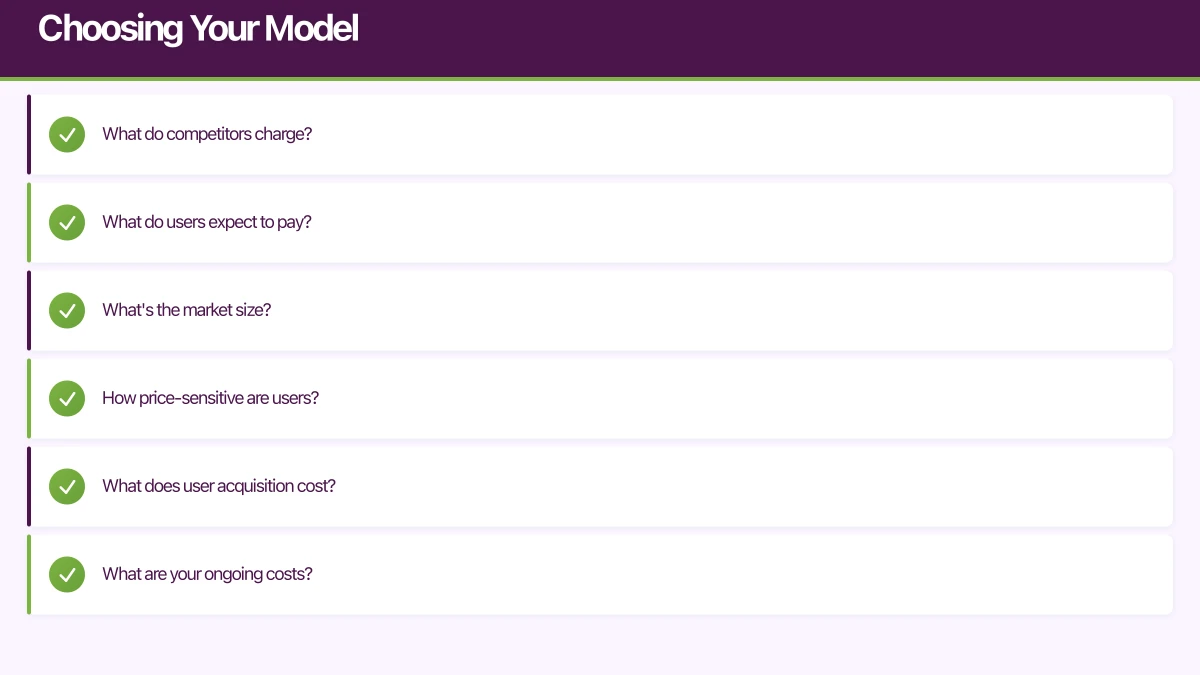
- What do competitors charge?
- What do users expect to pay?
- What’s the market size?
- How price-sensitive are users?
Consider Your Economics
- What does user acquisition cost?
- What are your ongoing costs?
- What revenue do you need to sustain development?
- What’s your break-even point?
Hybrid Models
Most successful apps combine models:
Freemium + Subscription Free tier with subscription for premium. Most common model for productivity and content apps.
Freemium + Ads Free with ads, payment removes ads and unlocks features. Common for utilities and casual games.
Ads + IAP (Rewarded) Free with ads, IAP for consumables, rewarded ads for free consumables. Standard for mobile games.
Subscription + IAP Subscription for base access, IAP for additional content or features. Used by content platforms.
Implementation Best Practices
Pricing Strategy
Research Competitors
- What do similar apps charge?
- What price points are common?
- What do reviews say about value vs. price?
Test Different Prices
- A/B test price points
- Consider geographic pricing
- Monitor conversion at different prices
Psychological Pricing
- $4.99 not $5.00
- Annual at “2 months free” messaging
- Show per-month price for annual plans
Conversion Optimisation
Free to Paid Conversion
- Demonstrate value before paywall
- Prompt at high-intent moments
- Make upgrade process frictionless
- Show what user is missing
Trial to Paid Conversion
- Remind before trial ends
- Show progress/value during trial
- Easy cancellation builds trust
- Consider extending trials for engaged users
Reducing Churn
For subscription apps:
- Continuous value delivery
- Regular content or feature updates
- Re-engagement for lapsed users
- Cancellation surveys to understand why
- Win-back offers for churned users
Platform Considerations
App Store Fees Both Apple and Google take 15-30% of in-app revenue:
- 30% standard
- 15% for subscriptions after first year
- 15% for developers under $1M annual revenue (Small Business Program)
Payment Processing Must use platform payment systems for digital goods. Physical goods and services can use external payment.
Regional Pricing Consider different pricing for different markets. Both platforms support this.
Australian-Specific Considerations
GST
Australian GST applies to digital sales:
- 10% GST on sales to Australian consumers
- App stores handle GST collection for most developers
- Understand your tax obligations
Local Payment Methods
Consider supporting:
- Afterpay/Zip Pay for larger purchases
- PayPal as alternative
- Local bank integrations where relevant
Market Characteristics
Australian app market:
- High smartphone penetration
- Strong spending power
- Lower population than US/UK (affects scale-dependent models)
- Users expect quality (willing to pay for value)
Measuring Success
Key Metrics to Track
Revenue Metrics
- Total revenue
- ARPU / ARPPU
- Revenue by source (subscriptions, IAP, ads)
- Revenue per user acquisition source
Conversion Metrics
- Free to paid conversion rate
- Trial to paid conversion rate
- Time to first purchase
- Upgrade prompts shown to converted ratio
Retention Metrics
- Subscription renewal rate
- Churn rate by cohort
- Returning purchaser rate
- LTV by user segment
When to Adjust
Signals to Change Strategy
- Conversion rate below 1% (freemium)
- High churn (subscription)
- Revenue per user too low to sustain
- User feedback about value vs. price
Testing Changes
- A/B test before full rollout
- Monitor impact on all metrics (not just revenue)
- Consider long-term effects
- Communicate changes to users
Conclusion
There’s no universally correct monetization model. The right choice depends on your app type, target market, competitive landscape, and business goals.
Key principles:
- Deliver genuine value before asking for money
- Match your model to user expectations in your category
- Test and optimise continuously
- Consider the long-term relationship, not just immediate revenue
- Make it easy for users who want to pay
The apps that monetize best are those where users feel they’re getting fair value. Focus on building something worth paying for, then make paying easy.
Drive more app downloads with a professional web presence. Cosmos Web Tech specialises in web design and SEO for Australian tech businesses.
Ashish Ganda is the founder of Ganda Tech Services, a Sydney-based technology consultancy helping Australian businesses grow through cloud, web, and mobile solutions.
Talk to a Sydney app developer — free.
30 minutes. We'll tell you what your app needs, how long it takes, and what it costs. Real answers, no sales pitch.
Book Free App Strategy Call →Free · 30 minutes · No obligation