React Native vs Flutter: Choosing Your Cross-Platform Framework
The cross-platform mobile development landscape has consolidated around two dominant frameworks: React Native and Flutter. Both promise to reduce development costs by sharing code across iOS and Android, but they take fundamentally different approaches to achieving that goal.
Having built production apps with both frameworks for Australian clients, we have developed strong opinions about when each one shines. This guide breaks down the key differences to help you make an informed decision for your next project.
The Current State of Play
React Native, released by Facebook (now Meta) in 2015, has a five-year head start. It has powered major apps including Facebook, Instagram, Shopify, and Discord. The ecosystem is mature, and the talent pool is substantial.
Flutter, released by Google in 2018, has caught up remarkably quickly. It powers apps like Google Pay, BMW, and Alibaba. Flutter 2.0, released in March 2021, expanded the framework beyond mobile to include web and desktop targets.
Both frameworks have active communities, regular releases, and strong corporate backing. Neither is going away any time soon.
Architecture: The Core Differe
 nce
nce
React Native
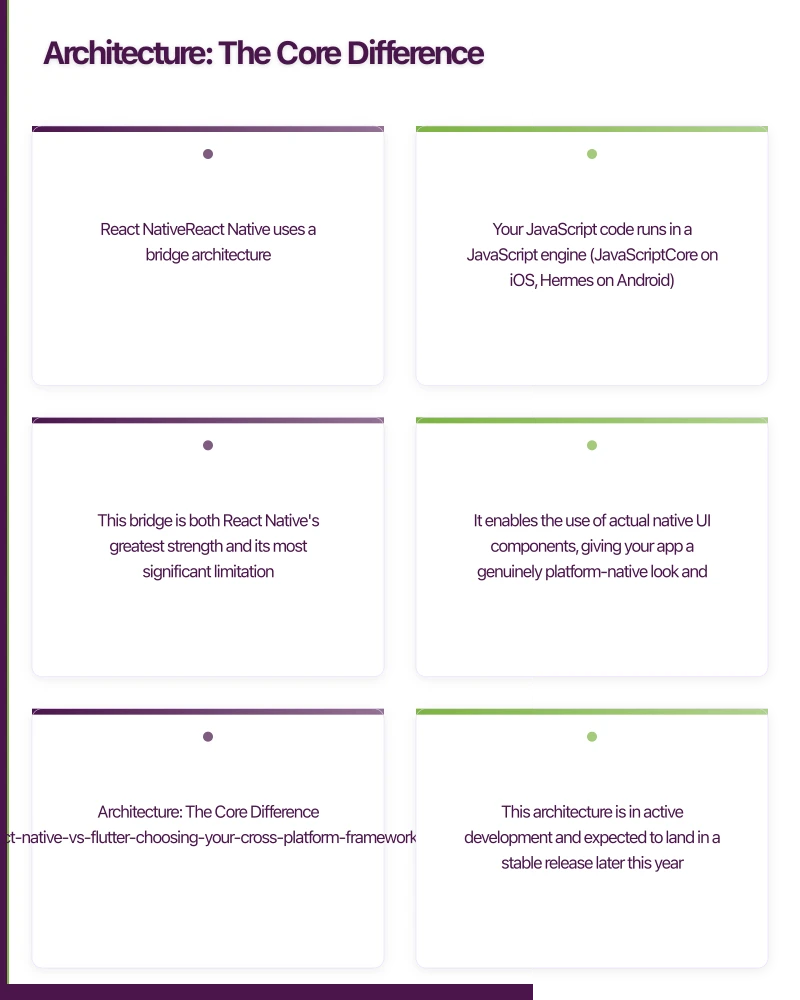
React Native uses a bridge architecture. Your JavaScript code runs in a JavaScript engine (JavaScriptCore on iOS, Hermes on Android). When your code needs to interact with native platform APIs or render native UI components, messages cross a bridge between the JavaScript thread and the native thread.
This bridge is both React Native’s greatest strength and its most significant limitation. It enables the use of actual native UI components, giving your app a genuinely platform-native look and feel. However, the serialisation and deserialisation of messages crossing the bridge introduces latency, particularly during heavy interactions like scrolling or complex animations.
Facebook has been working on a new architecture (codenamed “Fabric” and “TurboModules”) that replaces the bridge with a JavaScript Interface (JSI), enabling synchronous, direct communication between JavaScript and native code. This architecture is in active development and expected to land in a stable release later this year.
Flutter
Flutter takes a completely different approach. Instead of using native UI components, Flutter renders everything using its own rendering engine (Skia). Your Dart code compiles ahead-of-time to native ARM code, and the framework paints every pixel on a canvas.
This gives Flutter complete control over every pixel on screen, resulting in consistent rendering across platforms and smooth 60fps (or 120fps on supported devices) animations. The trade-off is that Flutter widgets are not native platform components. They look like native widgets, and Google has invested heavily in matching platform conventions, but they are drawn by Flutter’s engine.
Language Compari
son
JavaScript/TypeScript (React Native)
React Native uses JavaScript, the most widely known programming language in the world. If your team includes web developers, they can transition to React Native with relatively low friction. TypeScript support is excellent and increasingly standard.
// React Native component
const TaskCard = ({ title, completed, onToggle }) => {
  return (
    <TouchableOpacity onPress={onToggle} style={styles.card}>
      <View style={styles.row}>
        <Icon name={completed ? 'check-circle' : 'circle'} />
        <Text style={[styles.title, completed && styles.completed]}>
          {title}
        </Text>
      </View>
    </TouchableOpacity>
  );
};
Dart (Flutter)
Flutter uses Dart, a language developed by Google. Dart is clean, type-safe, and has excellent tooling. However, it is not widely used outside of Flutter, which means your team likely needs to learn it from scratch.
// Flutter widget
class TaskCard extends StatelessWidget {
  final String title;
  final bool completed;
  final VoidCallback onToggle;

  const TaskCard({
    required this.title,
    required this.completed,
    required this.onToggle,
  });

  @override
  Widget build(BuildContext context) {
    return GestureDetector(
      onTap: onToggle,
      child: Card(
        child: Row(
          children: [
            Icon(completed ? Icons.check_circle : Icons.circle_outlined),
            Text(
              title,
              style: TextStyle(
                decoration: completed ? TextDecoration.lineThrough : null,
              ),
            ),
          ],
        ),
      ),
    );
  }
}
Dart’s learning curve is gentle for developers familiar with Java, C#, or TypeScript. Most developers become productive within a week or two.
Performance Compari
 son
son
Performance is often cited as Flutter’s advantage, and in synthetic benchmarks, that is generally true. Flutter’s AOT compilation and direct rendering pipeline eliminate the overhead of the bridge architecture.
However, in real-world applications, the difference is often negligible for typical business apps. Most mobile apps are I/O-bound (network requests, database operations) rather than CPU-bound, and both frameworks handle these workloads well.
Where the difference becomes noticeable:
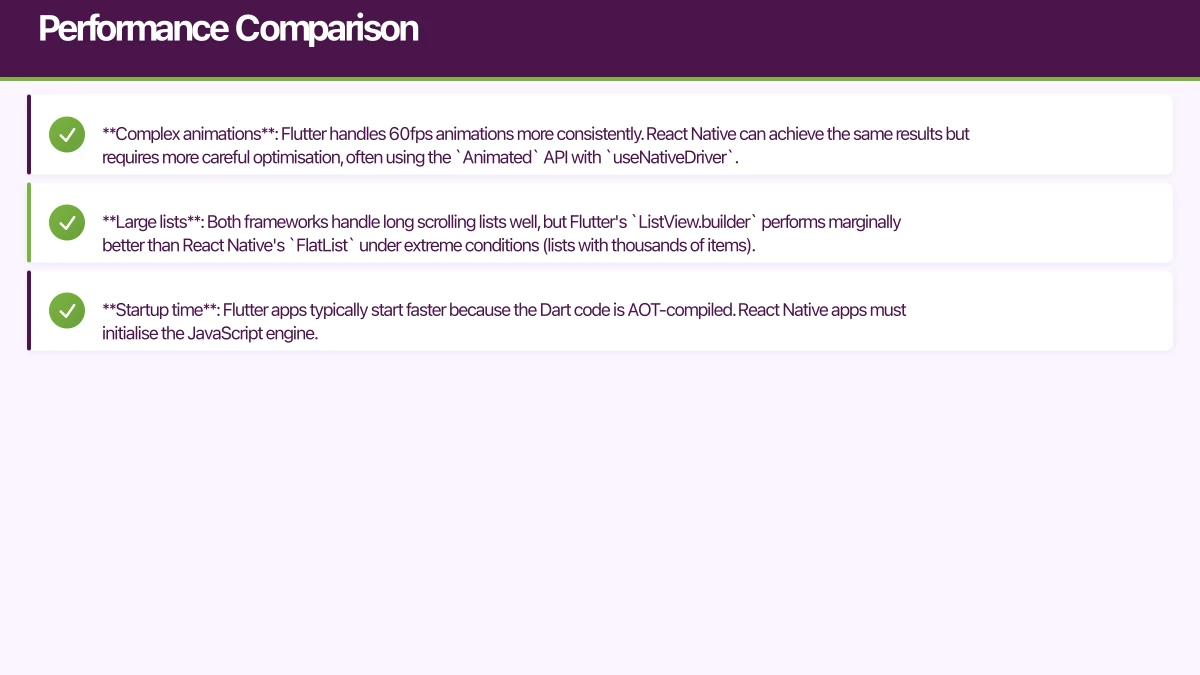
- Complex animations: Flutter handles 60fps animations more consistently. React Native can achieve the same results but requires more careful optimisation, often using the
AnimatedAPI withuseNativeDriver. - Large lists: Both frameworks handle long scrolling lists well, but Flutter’s
ListView.builderperforms marginally better than React Native’sFlatListunder extreme conditions (lists with thousands of items). - Startup time: Flutter apps typically start faster because the Dart code is AOT-compiled. React Native apps must initialise the JavaScript engine.
For the vast majority of Australian startup MVPs and business apps, both frameworks deliver acceptable performance.
Developer Experience
Hot Reload
Both frameworks support hot reload, but the experience differs.
Flutter’s hot reload is exceptionally fast and preserves application state reliably. You change code, save, and the changes appear in under a second with your app state intact. It works consistently and rarely requires a full restart.
React Native’s Fast Refresh (introduced in 0.61) has improved significantly. It handles most code changes well, though complex state changes occasionally require a full reload. The experience is good, but Flutter’s is marginally better.
Tooling
Flutter ships with a comprehensive CLI tool (flutter doctor) that diagnoses your development environment, and the Dart DevTools provide profiling, debugging, and widget inspection capabilities.
React Native relies more heavily on third-party tools. Flipper is the official debugging tool, and React DevTools handles component inspection. The tooling works well but requires more initial setup.
IDE Support
Both frameworks have excellent VS Code extensions. Flutter also has strong IntelliJ/Android Studio support with the official Dart plugin. React Native developers typically use VS Code with the React Native Tools extension.
Ecosystem and Libraries
React Native’s ecosystem is significantly larger, thanks to its five-year head start and the broader npm ecosystem. For almost any functionality you need, there is a community package available.
Flutter’s ecosystem has grown rapidly but is still smaller. The pub.dev package repository has fewer packages overall, though the quality of popular packages is generally high. Google provides many first-party packages for common functionality (camera, maps, in-app purchases), reducing reliance on community packages.
Key library comparison:
| Functionality | React Native | Flutter |
|---|---|---|
| Navigation | React Navigation | Navigator 2.0 / go_router |
| State Management | Redux, MobX, Recoil | Provider, Riverpod, BLoC |
| HTTP Client | Axios, fetch | http, Dio |
| Local Storage | AsyncStorage, MMKV | shared_preferences, Hive |
| Maps | react-native-maps | google_maps_flutter |
Native Module Integration
When you need functionality that the framework does not provide out of the box, you need to write native code.
React Native’s native module system allows you to write Objective-C/Swift (iOS) and Java/Kotlin (Android) code and expose it to JavaScript. The process is well-documented but involves boilerplate.
Flutter’s platform channels serve the same purpose. You write native code in Swift/Objective-C or Kotlin/Java and communicate with Dart through structured message passing. The API is clean, and the documentation is thorough.
In both cases, maintaining native modules adds complexity to your project. If your app relies heavily on platform-specific APIs, this is a significant consideration.
Community and Hiring
React Native benefits from the massive JavaScript developer community. Finding React Native developers in Australia is relatively straightforward, and web developers with React experience can transition quickly.
Flutter’s community is smaller but growing rapidly. The 2020 Stack Overflow developer survey showed Flutter as the most loved framework among cross-platform developers. Hiring Flutter developers in Australia is harder today, but the supply is increasing.
If you are building an in-house team, consider your existing talent. A team of React web developers will ramp up faster on React Native. A team without strong JavaScript skills might find Flutter’s Dart language refreshing.
When to Choose React Native
React Native is the better choice when:
- Your team has strong JavaScript/React expertise
- You need to share code between mobile and web (React Native Web)
- You depend on specific npm packages with no Flutter equivalent
- You want the UI to feel truly native on each platform
- You need to integrate with an existing native codebase incrementally
When to Choose Flutter
Flutter is the better choice when:
- Performance and smooth animations are critical
- You want pixel-perfect UI consistency across platforms
- You are building a design-heavy, branded experience
- Your team is starting fresh without existing JavaScript expertise
- You want a comprehensive, batteries-included framework
Our Recommendation for Australian Startups
For most Australian startups building an MVP in 2021, we lean slightly toward Flutter. The developer experience is excellent, performance is strong out of the box, and the framework’s rapid growth suggests a healthy long-term trajectory.
However, React Native remains a rock-solid choice, especially for teams with existing React expertise. The new architecture work promises significant performance improvements, and the ecosystem maturity is a genuine advantage.
The wrong choice is not choosing. Both frameworks dramatically reduce the cost of cross-platform development compared to building two native apps. Pick the one that aligns with your team’s skills and your app’s requirements, and start building.
At eawesome, we have delivered production apps with both frameworks and are happy to help you evaluate which is the right fit for your project. The best framework is the one that gets your product into users’ hands faster.
An app is only as reliable as its backend. Cloud Geeks manages cloud hosting and security for mobile-first Australian businesses.
Awesome Apps operates under the Ganda Tech Services umbrella, delivering end-to-end technology solutions for Australian businesses.
Talk to a Sydney app developer — free.
30 minutes. We'll tell you what your app needs, how long it takes, and what it costs. Real answers, no sales pitch.
Book Free App Strategy Call →Free · 30 minutes · No obligation