Native vs Cross-Platform Development in 2025: The Ultimate Guide to Choosing Your App Strategy
The mobile app development field has evolved dramatically over the past few years, and 2025 presents developers and businesses with more sophisticated options than ever before. The age-old debate between native and cross-platform development continues, but with new frameworks, improved tooling, and changing market demands, the decision has become more nuanced.
Whether you’re a startup looking to launch your first app or an established business considering a mobile expansion, choosing between native and cross-platform development will significantly impact your project’s success, timeline, and budget. Let’s dive deep into what each approach offers in 2025 and help you make an informed decision.
The Current State of Native Development in 2025
Native development remains the gold standard for apps that demand the highest performance and deepest platform integration. In 2025, both iOS and Android platforms have introduced powerful new capabilities that are exclusively available to native apps.
iOS Native Development
Apple’s environment continues to thrive with Swift 6.0 bringing enhanced concurrency features and improved memory safety. The introduction of visionOS has opened new possibilities for spatial computing, while iOS 18’s advanced AI capabilities provide native developers with unprecedented access to on-device machine learning.
Native iOS apps can leverage:
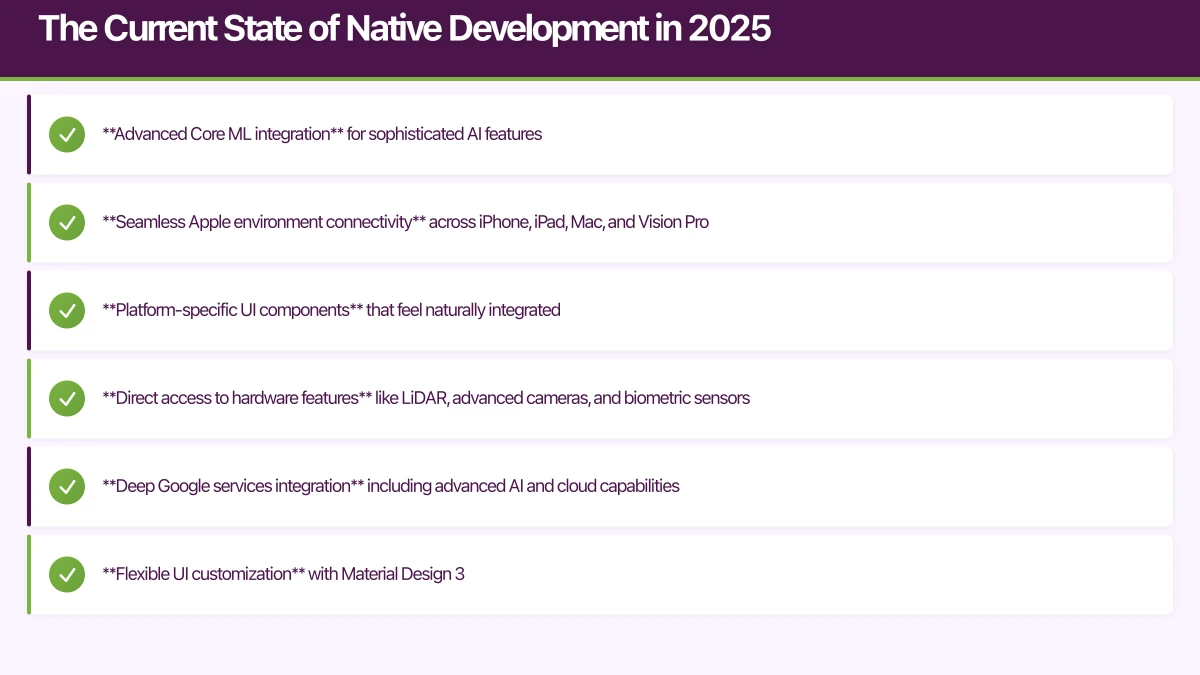
- Advanced Core ML integration for sophisticated AI features
- Seamless Apple environment connectivity across iPhone, iPad, Mac, and Vision Pro
- Platform-specific UI components that feel naturally integrated
- Direct access to hardware features like LiDAR, advanced cameras, and biometric sensors
Android Native Development
Google’s Android platform has embraced Kotlin as the preferred language, with Kotlin Multiplatform gaining traction. Android 15 introduces enhanced privacy controls, improved battery optimization, and better support for foldable devices.
Native Android development offers:
- Deep Google services integration including advanced AI and cloud capabilities
- Flexible UI customization with Material Design 3
- Extensive hardware compatibility across thousands of device variations
- Advanced background processing capabilities
When to Choose Native Development
Native development is your best choice when:
- Performance is absolutely critical (gaming, AR/VR, complex animations)
- You need deep platform integration (payments, enterprise security, hardware sensors)
- Your app requires platform-specific features that aren’t available cross-platform
- You have separate teams specialized in iOS and Android development
- Budget allows for maintaining two separate codebases
Cross-Platform De
 velopment: The 2025 Field
Cross-platform development has matured significantly, with frameworks like Flutter, React Native, and newer entrants offering compelling alternatives to native development. The promise of “write once, run everywhere” is closer to reality than ever before.
Flutter’s Continued Evolution
Google’s Flutter has established itself as a leader in cross-platform development. Flutter 3.5 and beyond offer:
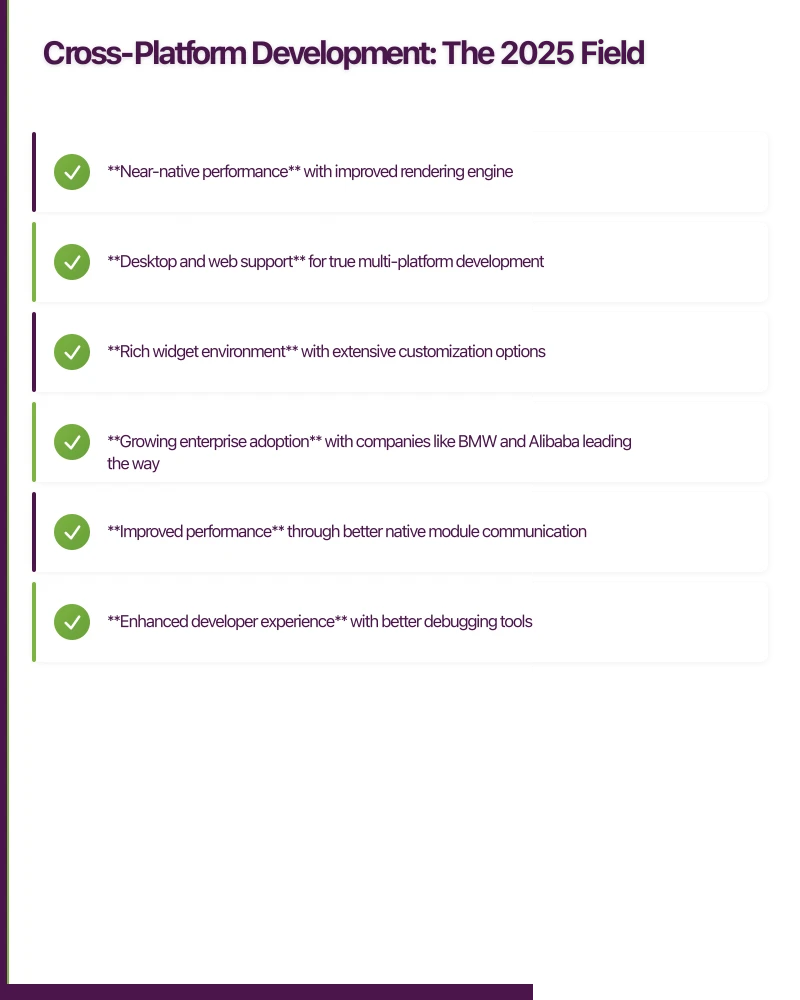
- Near-native performance with improved rendering engine
- Desktop and web support for true multi-platform development
- Rich widget environment with extensive customization options
- Growing enterprise adoption with companies like BMW and Alibaba leading the way
React Native’s Renaissance
Meta’s React Native has undergone significant improvements with the New Architecture (Fabric and TurboModules):
- Improved performance through better native module communication
- Enhanced developer experience with better debugging tools
- Stronger TypeScript support for more robust development
- Large community and environment with extensive third-party libraries
Emerging Cross-Platform Solutions
New players are entering the market:
- Kotlin Multiplatform Mobile (KMM) for sharing business logic while keeping native UI
- .NET MAUI for Microsoft-focused development teams
- Xamarin’s evolution into more modern cross-platform solutions
Cross-Platform Advantages in 2025
- Faster time to market with single codebase deployment
- Cost efficiency with unified development teams
- Consistent user experience across platforms
- Easier maintenance and feature updates
- Growing platform parity with native capabilities
Performance and U
 ser Experience Comparison
The performance gap between native and cross-platform apps has narrowed considerably, but differences still exist depending on your app’s requirements.
Performance Benchmarks
Native apps still lead in:
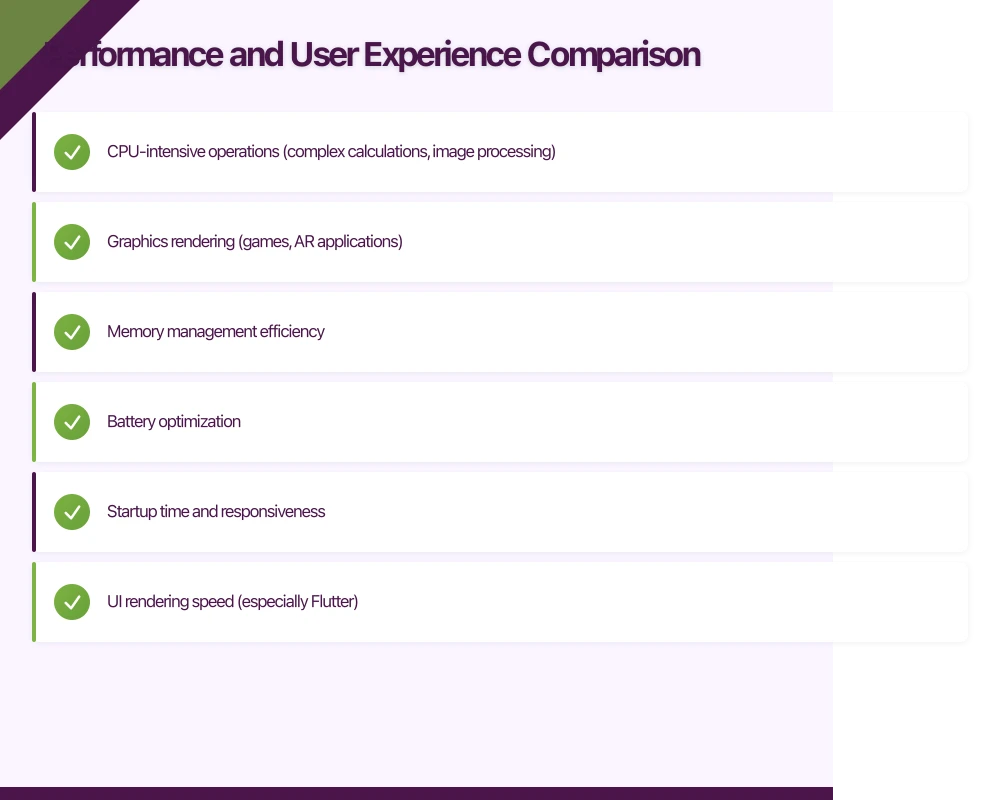
- CPU-intensive operations (complex calculations, image processing)
- Graphics rendering (games, AR applications)
- Memory management efficiency
- Battery optimization
- Startup time and responsiveness
Cross-platform apps have improved significantly in:
- UI rendering speed (especially Flutter)
- Network operations and API calls
- Basic user interactions and animations
- Form handling and data input
User Experience Considerations
Native apps provide:
- Platform-specific design patterns users expect
- Seamless integration with system features
- Optimal touch responsiveness and haptic feedback
- Natural navigation patterns
Cross-platform apps offer:
- Consistent experience across devices
- Faster feature rollouts
- Unified design language
- Good-enough native feel for most use cases
Real-World Performance Examples
E-commerce apps like Shopify use React Native successfully, proving cross-platform viability for complex business applications. However, gaming apps like Pokemon GO rely on native development for optimal AR performance and battery efficiency.
Social media apps present interesting case studies: Instagram uses React Native for certain features while keeping core functionality native, demonstrating a hybrid app
 roach’s effectiveness.
Cost Analysis and Development Timeline
Budget considerations often drive the native vs cross-platform decision, but the calculation involves more than just initial development costs.
Development Costs Breakdown
Native Development:
- Higher upfront costs (2 separate teams/codebases)
- Specialist developers command higher salaries
- Longer initial development timeline
- Higher ongoing maintenance costs
- Platform-specific testing requirements
Cross-Platform Development:
- Lower initial development investment
- Single team can handle both platforms
- Faster initial deployment
- Shared maintenance and updates
- Unified testing processes
Hidden Costs to Consider
Native apps may require:
- Separate UI/UX design for each platform
- Platform-specific third-party licenses
- Different deployment and maintenance pipelines
- Specialized knowledge for each environment
Cross-platform apps might need:
- Additional native development for specific features
- Performance optimization work
- Platform-specific testing despite shared codebase
- Framework-specific expertise
Timeline Considerations
Typical Development Timelines (Medium Complexity App):
- Native (both platforms): 8-12 months
- Cross-platform: 4-8 months
- Hybrid approach: 6-10 months
ROI Analysis
For most businesses, cross-platform development offers better short-term ROI, especially for:
- MVP development and market validation
- Apps with standard functionality
- Startups with limited budgets
- Rapid iteration requirements
Native development provides better long-term ROI when:
- Performance directly impacts revenue
- Platform-specific features are core to the business
- User experience is a key differentiator
- Scale justifies the additional investment
Making the Right Choice: A Decision Framework
Choosing between native and cross-platform development requires careful consideration of multiple factors. Here’s a systematic approach to making the right decision for your project.
Project Assessment Matrix
Choose Native Development if:
- Performance requirements are critical (score 8+/10)
- Platform-specific features are essential
- You have sufficient budget for dual development
- Long-term maintenance resources are available
- User experience differentiation is crucial
- Enterprise security requirements are stringent
Choose Cross-Platform Development if:
- Time to market is the primary concern
- Budget constraints are significant
- Feature set is standard/common
- Team has limited mobile expertise
- Consistent multi-platform experience is desired
- MVP or proof-of-concept development
Industry-Specific Recommendations
Financial Services: Native development for security and compliance E-commerce: Cross-platform for faster market entry Gaming: Native for performance-critical applications Social Media: Hybrid approach with cross-platform core Enterprise B2B: Cross-platform for cost efficiency Healthcare: Native for regulatory compliance and security
Team and Resource Evaluation
Consider your team’s:
- Current expertise in mobile technologies
- Learning capacity for new frameworks
- Long-term commitment to mobile development
- Budget allocation for training and tools
- Project timeline constraints
Future-Proofing Considerations
Technology Evolution:
- Cross-platform frameworks are rapidly improving
- Platform convergence is increasing
- Development tools are becoming more sophisticated
- Performance gaps are narrowing
Market Trends:
- User expectations for app performance continue rising
- Platform-specific features remain important differentiators
- Development costs are a growing concern for businesses
- Multi-platform presence is increasingly essential
Conclusion: Your 2025 Mobile Development Strategy
The native vs cross-platform debate in 2025 isn’t about finding a universal winner—it’s about finding the right fit for your specific project, team, and business goals. Both approaches have evolved to offer compelling advantages, and the gap between them continues to narrow.
Key Takeaways
-
Cross-platform development has matured significantly and offers excellent value for most standard applications, especially with frameworks like Flutter and the improved React Native architecture.
-
Native development remains the superior choice for performance-critical applications, complex platform integrations, and scenarios where user experience is a key differentiator.
-
Hybrid approaches are increasingly viable, allowing teams to leverage cross-platform development for core functionality while going native for specific features.
-
Team expertise and resources often matter more than technical considerations—choose the approach that aligns with your team’s strengths and growth plans.
-
Market validation should influence your decision—cross-platform might be perfect for testing market fit, with native development following successful validation.
Moving Forward
As we progress through 2025, the mobile development field will continue evolving. The most successful teams will be those that remain flexible, continuously evaluate new technologies, and make decisions based on current project needs rather than past assumptions.
Whether you choose native, cross-platform, or a hybrid approach, focus on delivering value to your users while building sustainable development practices for your team. The “right” choice is the one that helps you achieve your business objectives efficiently and effectively.
Remember, your mobile development strategy isn’t set in stone—you can always evolve your approach as your app grows, your team develops new expertise, and technology continues to advance. The key is making an informed decision based on your current reality while staying adaptable for the future.
Looking at the strategic side of app investment? Ash Ganda covers technology ROI and digital maturity for growing Australian businesses.
Awesome Apps operates under the Ganda Tech Services umbrella, delivering end-to-end technology solutions for Australian businesses.
Talk to a Sydney app developer — free.
30 minutes. We'll tell you what your app needs, how long it takes, and what it costs. Real answers, no sales pitch.
Book Free App Strategy Call →Free · 30 minutes · No obligation