Introduction
As we approach the end of 2021, the mobile app development landscape stands at an exciting inflection point. The rapid acceleration of digital transformation driven by the pandemic continues to reshape how businesses and consumers interact through mobile applications. For app founders and development teams planning their 2022 roadmaps, understanding the emerging trends is crucial for making informed technology decisions.
This preview examines the key trends we expect to dominate mobile app development in 2022, based on current industry momentum, platform announcements, and the evolving needs of Australian businesses and users.
5G Adoption Reaches Critical Mass
The
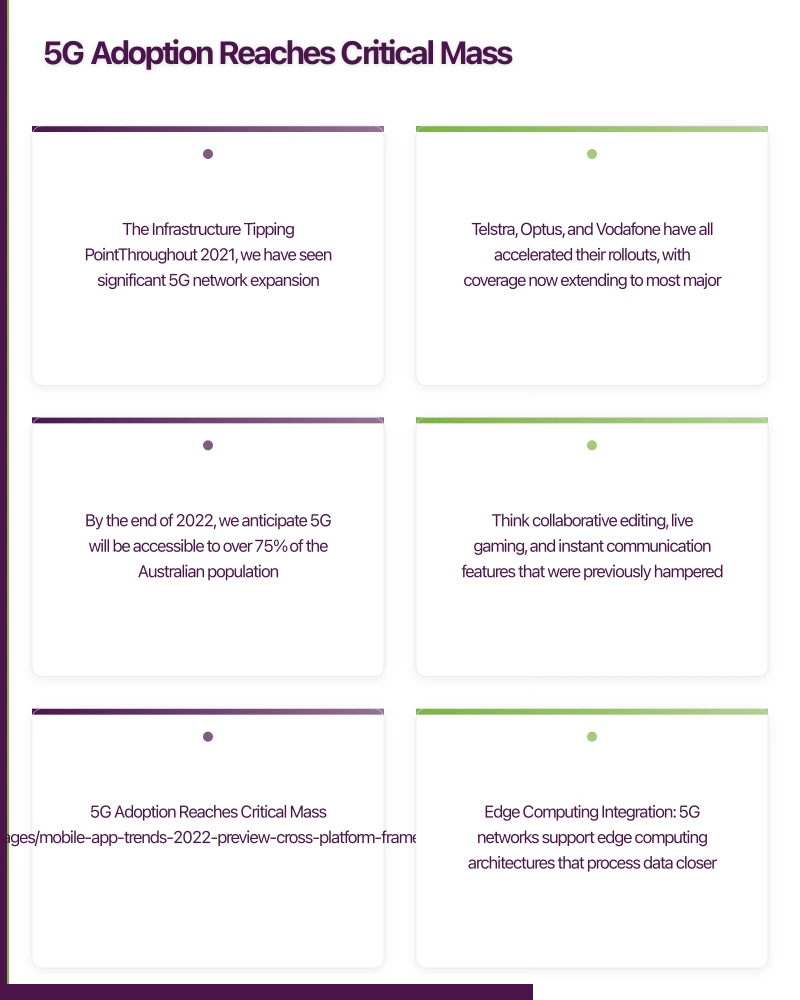 Infrastructure Tipping Point
Throughout 2021, we have seen significant 5G network expansion across Australian metropolitan areas. Telstra, Optus, and Vodafone have all accelerated their rollouts, with coverage now extending to most major cities and suburban areas. By the end of 2022, we anticipate 5G will be accessible to over 75% of the Australian population.
For mobile app developers, this infrastructure expansion opens new possibilities:
Enhanced Real-Time Features: With latency dropping below 10 milliseconds in optimal conditions, applications requiring real-time data synchronisation become far more viable. Think collaborative editing, live gaming, and instant communication features that were previously hampered by network delays.
Richer Media Experiences: The bandwidth improvements of 5G, offering speeds up to 100 times faster than 4G, enable apps to deliver high-definition video streaming, augmented reality experiences, and large file transfers without the traditional waiting periods that frustrated users.
Edge Computing Integration: 5G networks support edge computing architectures that process data closer to the user. Apps can offload complex computations to nearby servers, enabling features like real-time translation, advanced image processing, and AI-powered recommendations without draining device batteries.
Practical Considerations for Developers
While 5G promises significant capabilities, developers must design apps that gracefully handle varying network conditions. Not all users will have 5G access, and even those who do will move between coverage areas. Progressive enhancement strategies that deliver core functionality on any connection while enabling premium features on faster networks will be essential.
Cross-Platform Frameworks Mature
Flut
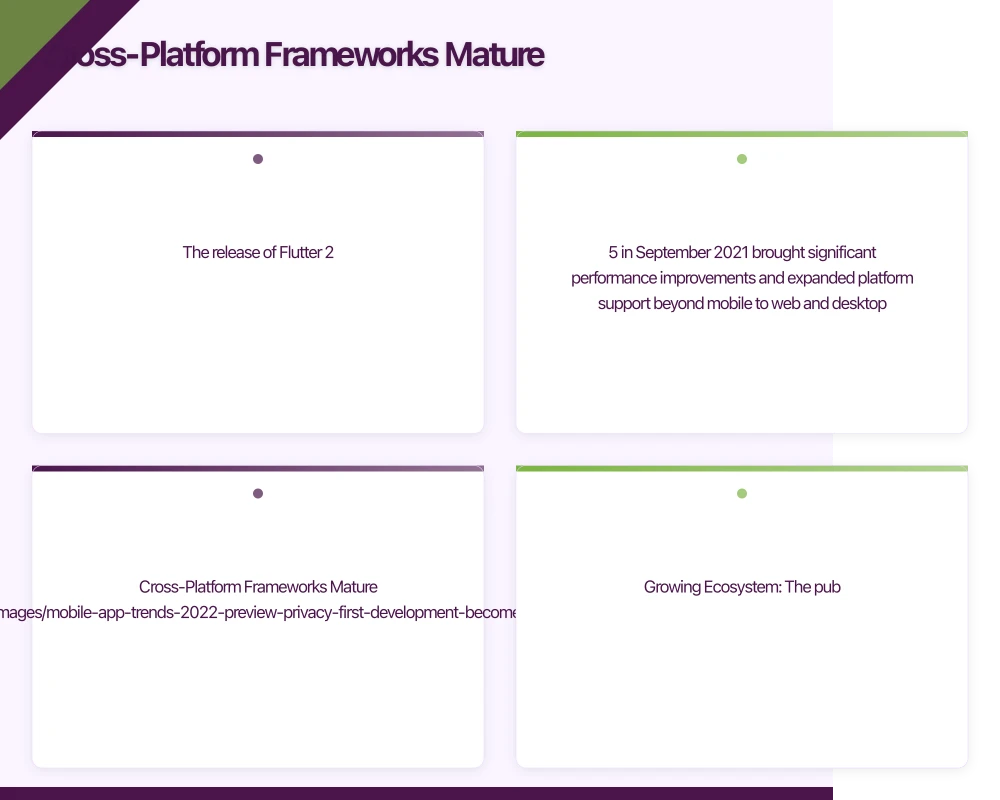 ter’s Rising Dominance
Google’s Flutter framework has gained remarkable traction throughout 2021, and we expect this momentum to accelerate in 2022. The release of Flutter 2.5 in September 2021 brought significant performance improvements and expanded platform support beyond mobile to web and desktop applications.
For Australian startups and businesses with limited budgets, Flutter offers compelling advantages:
Single Codebase Efficiency: Teams can target iOS, Android, web, and desktop from one Dart codebase, reducing development time by 30-50% compared to maintaining separate native applications.
Consistent UI Across Platforms: Flutter’s widget-based architecture ensures pixel-perfect consistency between platforms, simplifying design implementation and QA processes.
Growing Ecosystem: The pub.dev package repository now hosts over 25,000 packages, providing pre-built solutions for common functionality from authentication to analytics.
Major Australian brands including Commonwealth Bank and REA Group have invested in Flutter for specific applications, validating the framework’s production readiness.
React Native Remains Strong
Despite Flutter’s growth, React Native maintains a substantial market presence, particularly among teams with existing JavaScript expertise. The ongoing work on the New Architecture, expected to become more widely available in 2022, promises to address long-standing performance concerns.
React Native’s integration with the broader React ecosystem and the availability of experienced developers make it a pragmatic choice for many projects. The framework’s battle-tested nature, powering apps like Facebook, Instagram, and Shopify, provides confidence for enterprise deployments.
Privacy-First Development Becomes Mandatory
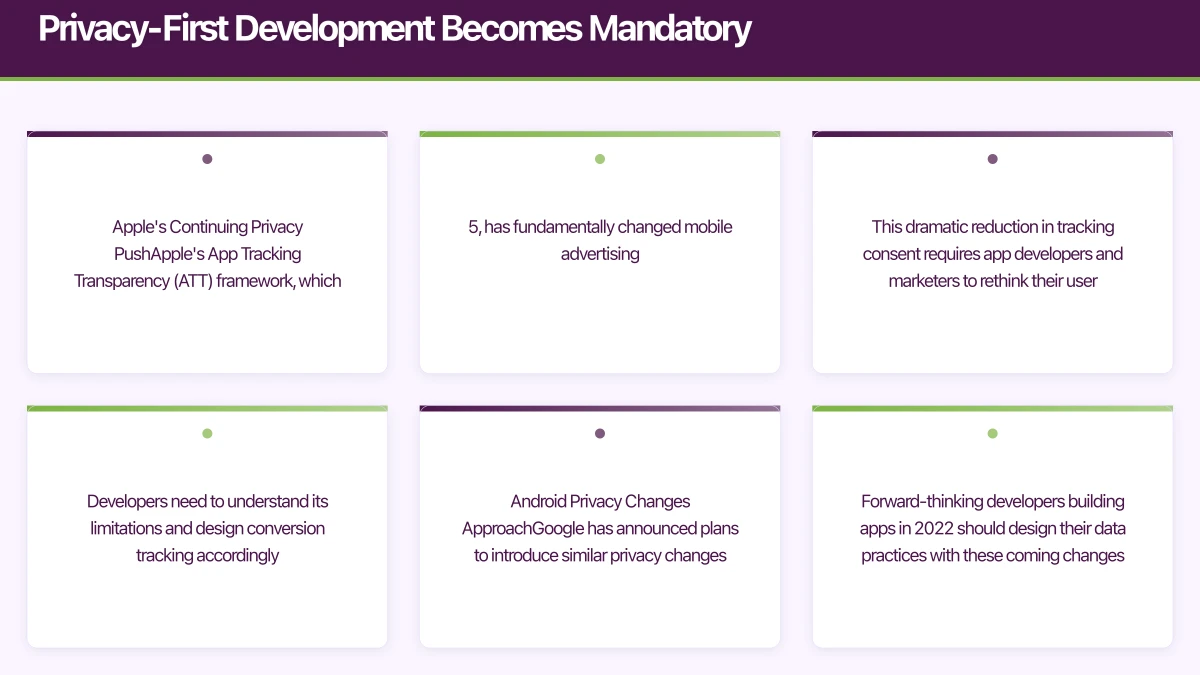
Apple’s Continuing Privacy Push
Apple’s App Tracking Transparency (ATT) framework, which became mandatory in iOS 14.5, has fundamentally changed mobile advertising. As we enter 2022, the full impact of these changes is becoming clear:
User Opt-In Rates: Data from various analytics providers suggests that only 15-25% of users choose to allow tracking when prompted. This dramatic reduction in tracking consent requires app developers and marketers to rethink their user acquisition and monetisation strategies.
First-Party Data Emphasis: Apps that build direct relationships with users and collect first-party data with clear value exchange will have significant advantages. Features like personalised experiences, loyalty programs, and premium content that encourage users to share information willingly become more valuable.
SKAdNetwork Adaptation: Apple’s privacy-preserving SKAdNetwork for measuring advertising effectiveness requires new approaches to campaign optimisation. Developers need to understand its limitations and design conversion tracking accordingly.
Android Privacy Changes Approach
Google has announced plans to introduce similar privacy changes to Android, with a timeline extending through 2023. Forward-thinking developers building apps in 2022 should design their data practices with these coming changes in mind. The principle of minimal data collection and transparent user communication will serve apps well regardless of specific platform requirements.
Super Apps and Mini Programs Gain Traction
The Platform Within Platform Model
The super app model, pioneered by WeChat in China and Grab in Southeast Asia, is beginning to influence Australian app development thinking. While we may not see full-fledged super apps emerge locally in 2022, the underlying principles are affecting app strategy:
Service Aggregation: Major apps are expanding beyond their core functionality to become platforms. Banking apps add shopping and payments. Retail apps integrate loyalty and services. This consolidation creates sticky ecosystems that increase user retention.
Instant App Experiences: Both Apple App Clips and Google Play Instant allow users to experience app functionality without full installation. These technologies enable discovery and reduce friction for new users. In 2022, we expect more apps to implement these capabilities, particularly for transactional use cases like payments and reservations.
Third-Party Integrations: APIs and SDKs that allow apps to embed functionality from other services will proliferate. Payment integrations, identity verification, and communication tools become building blocks for creating comprehensive experiences.
Augmented Reality Moves Beyond Novelty
AR Development Tools Mature
Both Apple’s ARKit and Google’s ARCore have evolved significantly, making AR development more accessible. In 2022, we expect AR features to move from novelty experiments to practical utility:
Retail and E-Commerce: Virtual try-on experiences for fashion, cosmetics, and furniture have proven to increase purchase confidence and reduce returns. Australian retailers are increasingly adopting these technologies.
Navigation and Wayfinding: AR overlays that guide users through physical spaces, from shopping centres to airports, provide intuitive navigation that traditional maps cannot match.
Training and Education: AR-enhanced learning experiences that overlay information on real-world objects create engaging educational content. Australian educational technology companies are investing in these capabilities.
Development Considerations
Building effective AR experiences requires attention to user experience design, device capability detection, and graceful degradation for devices without AR support. The computational demands of AR also require careful performance optimisation to maintain smooth frame rates while preserving battery life.
Voice and Conversational Interfaces Expand
Beyond Simple Commands
Voice interfaces have moved beyond simple command-and-response patterns to more sophisticated conversational experiences. Siri Shortcuts, Google Assistant integrations, and Alexa skills allow apps to extend their functionality into voice-first contexts.
For 2022, we anticipate:
In-App Voice Features: Rather than relying solely on platform assistants, more apps will incorporate native voice recognition for specific use cases. Dictation, voice search, and hands-free navigation become standard features where appropriate.
Multilingual Support: Australia’s multicultural population creates demand for apps that understand and respond in multiple languages. Advances in natural language processing make multilingual voice features increasingly practical.
Accessibility Integration: Voice interfaces provide essential accessibility for users with visual impairments or motor limitations. Apps that design voice experiences from the outset serve broader user bases.
Subscription and In-App Purchase Evolution
App Store Economics Shift
The legal and regulatory challenges to app store commission structures, highlighted by the Epic Games versus Apple case, suggest that the economics of mobile apps may shift in 2022. While dramatic immediate changes are unlikely, developers should monitor developments:
Alternative Payment Options: Regulatory pressure may eventually force Apple and Google to allow alternative payment methods. Developers should understand the implications for their business models.
Subscription Optimisation: With subscription fatigue affecting consumer willingness to pay recurring fees, apps must demonstrate ongoing value. Features like pause options, flexible tiers, and usage-based pricing help retain subscribers.
Hybrid Monetisation: Combining advertising, subscriptions, and in-app purchases into hybrid models that serve different user segments becomes more sophisticated. Analytics and experimentation platforms support these strategies.
Security and Trust Become Differentiators
User Security Awareness Grows
High-profile data breaches and privacy scandals have increased user awareness of security practices. Apps that visibly prioritise security and communicate their practices clearly can differentiate themselves:
Biometric Authentication: Face ID and fingerprint authentication have become user expectations for sensitive applications. Implementing these features properly, with appropriate fallbacks, builds trust.
Transparent Privacy Policies: Clear, readable privacy policies that explain data practices in plain language demonstrate respect for users. Australian Privacy Principles require certain disclosures, but going beyond minimum requirements builds confidence.
Security Certifications: For apps handling sensitive data, particularly in finance and health, pursuing relevant security certifications and compliance demonstrates commitment to protection.
Conclusion and Strategic Recommendations
As we prepare for 2022, mobile app developers and product teams should consider these strategic priorities:
Invest in Cross-Platform Capabilities: Unless your app requires deep native platform integration, cross-platform frameworks offer compelling efficiency benefits. Evaluate Flutter and React Native against your team’s skills and project requirements.
Design for Privacy First: Build data collection and advertising strategies that respect user privacy and anticipate continued platform restrictions. First-party data and direct user relationships become increasingly valuable.
Prepare for 5G Features: While maintaining backwards compatibility, architect your applications to take advantage of faster networks when available. Consider what enhanced features become possible with reliable high-bandwidth connections.
Focus on User Value: In a crowded app market, differentiation comes from solving real user problems effectively. Invest in understanding your target users and delivering experiences that genuinely improve their lives.
The mobile app landscape in 2022 offers tremendous opportunities for teams that stay informed about technology trends while remaining focused on user needs. The coming year will reward developers who combine technical excellence with thoughtful product thinking.
Planning your mobile app strategy for 2022? Contact Awesome Apps to discuss how emerging trends apply to your specific business needs and target audience.
From staging environments to production servers, Cloud Geeks manages the cloud infrastructure that mobile apps depend on.
This article is brought to you by Ganda Tech Services — Sydney’s complete digital solutions provider covering cloud, web, and mobile.
Talk to a Sydney app developer — free.
30 minutes. We'll tell you what your app needs, how long it takes, and what it costs. Real answers, no sales pitch.
Book Free App Strategy Call →Free · 30 minutes · No obligation