Native vs Cross-Platform Mobile App Development in 2025: The Complete Decision Guide
The mobile app development landscape has evolved dramatically over the past few years, and 2025 presents developers and businesses with more sophisticated options than ever before. One of the most critical decisions you’ll face when planning your mobile app is choosing between native and cross-platform development approaches.
This choice will fundamentally impact your app’s performance, development timeline, budget, and long-term maintenance strategy. With cross-platform frameworks becoming increasingly mature and native development tools continuing to advance, the decision has become more nuanced than the simple “performance vs cost” trade-off of previous years.
In this comprehensive guide, we’ll explore the current state of both approaches, analyze real-world scenarios, and provide you with the insights needed to make an informed decision for your 2025 mobile app project.
Understanding the Current Landscape: What’s Changed in 2025
The mobile development ecosystem has undergone significant transformations that directly impact the native vs cross-platform debate. Cross-platform frameworks like Flutter and React Native have matured considerably, offering near-native performance and access to platform-specific features that were previously exclusive to native development.
Cross-Platform Evolution
Flutter has reached new heights of stability and performance, with Google’s continued investment resulting in improved compilation speeds and smaller app bundles. The framework now offers excellent web and desktop support, making it a truly universal solution. React Native, backed by Meta’s ongoing development, has introduced new architecture improvements including the New Architecture (Fabric and TurboModules) that significantly enhance performance and reduce the JavaScript bridge overhead.
Native Development Advances
On the native side, Apple’s SwiftUI and Google’s Jetpack Compose have revolutionized native development, making it faster and more declarative. These modern frameworks have reduced the traditional complexity of native development while maintaining the performance advantages that native apps are known for.
Market Demands
User expectations continue to rise, with demands for seamless performance, instant load times, and platform-specific user experiences. Simultaneously, businesses are under pressure to reduce time-to-market and development costs while maintaining high-quality standards across multiple pl
atforms.
Native Development: When Platform-Specific Excellence Matters

Native development remains the gold standard for applications that require maximum performance, deep platform integration, or highly specialized functionality. Building separate apps for iOS and Android using platform-specific languages and tools offers unparalleled access to device capabilities and platform features.
Performance Advantages
Native apps consistently deliver superior performance, particularly for computationally intensive applications like games, AR/VR experiences, or complex data processing apps. Direct compilation to machine code eliminates the overhead present in cross-platform solutions, resulting in faster execution and more efficient memory usage.
Consider apps like Instagram or Spotify - while they’ve experimented with cross-platform solutions for certain features, their core functionality remains native to ensure smooth scrolling, seamless media playback, and responsive user interactions.
Platform Integration and Features
Native development provides immediate access to the latest platform features and APIs. When Apple introduces new iOS capabilities or Google releases Android updates, native developers can implement these features immediately without waiting for cross-platform framework support.
Examples include advanced camera features, biometric authentication improvements, or platform-specific design patterns that users expect. Banking apps, for instance, often choose native development to leverage the most secure authentication methods and platform-specific security features.
User Experience Excellence
Native apps naturally follow platform-specific design guidelines and user interface patterns. iOS users expect certain behaviors and visual elements that differ from Android expectations. Native development allows for pixel-perfect implementations of these design systems, creating more intuitive user experiences.
When to Choose Native
- Performance-critical applications (games, AR/VR, real-time processing)
- Apps requiring cutting-edge platform features
- Complex user interfaces with platform-specific interactions
- Applications handling sensitive data requiring maximum
 security
- Projects with sufficient budget and timeline for platform-specific development
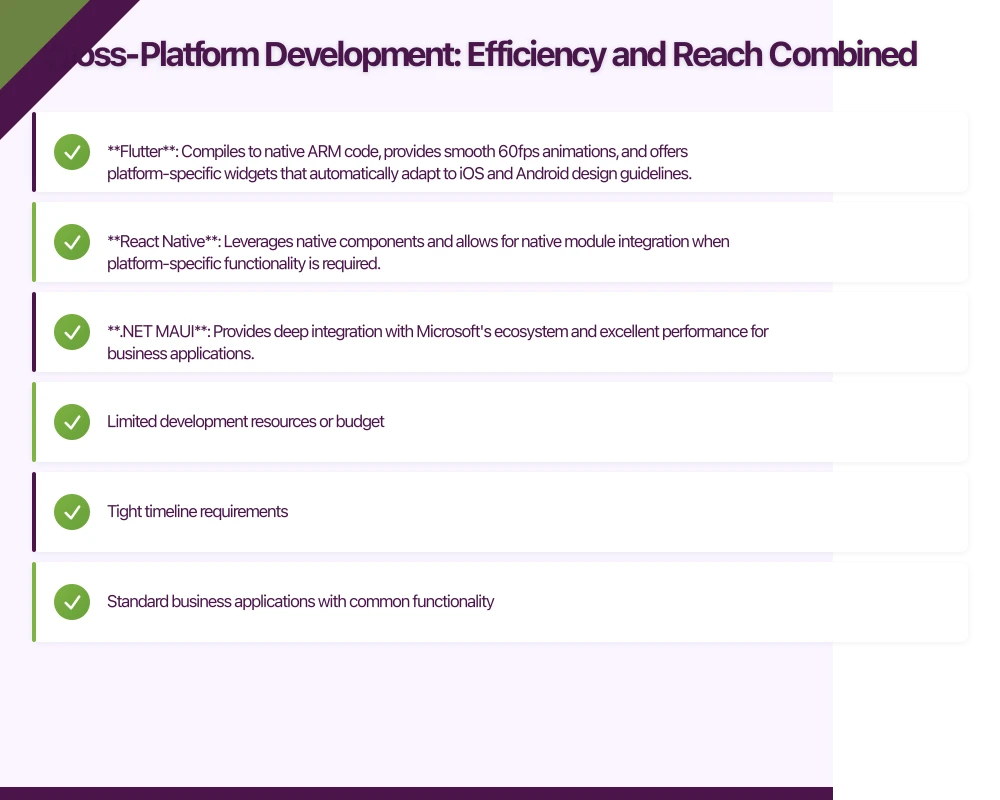
Cross-Platform Development: Efficiency and Reach Combined
Cross-platform development has evolved from a compromise solution to a legitimate first choice for many applications. Modern frameworks offer compelling advantages that make them suitable for a wide range of projects, from startups to enterprise applications.
Development Efficiency
The primary advantage of cross-platform development is the ability to maintain a single codebase for multiple platforms. This approach significantly reduces development time, particularly for teams with limited resources or tight deadlines. Companies like Alibaba, BMW, and Nubank have successfully built complex applications using Flutter, demonstrating the viability of cross-platform solutions for enterprise-grade applications.
Cost Considerations
Maintaining one codebase instead of two or more separate native applications reduces both initial development costs and ongoing maintenance expenses. This cost efficiency is particularly valuable for startups, small businesses, or projects with limited budgets.
Rapid Iteration and Updates
Cross-platform development enables faster iteration cycles and simultaneous updates across all platforms. Bug fixes, feature additions, and improvements can be deployed universally, ensuring consistency across platforms and reducing the complexity of managing multiple codebases.
Modern Framework Capabilities
Today’s cross-platform frameworks offer impressive capabilities that bridge the gap with native development:
- Flutter: Compiles to native ARM code, provides smooth 60fps animations, and offers platform-specific widgets that automatically adapt to iOS and Android design guidelines.
- React Native: Leverages native components and allows for native module integration when platform-specific functionality is required.
- .NET MAUI: Provides deep integration with Microsoft’s ecosystem and excellent performance for business applications.
When to Choose Cross-Platform
- Limited development resources or budget
- Tight timeline requirements
- Standard business applications with common functionality
- MVP or proof-of-concept development
- Teams with existing expertise in relevant technologies (JavaScript for React Native, Dart f
 or Flutter)
Performance, Cost, and Timeline Analysis: The Real Numbers

Making an informed decision requires understanding the practical implications of each approach across key metrics that matter to your project’s success.
Performance Comparison
Recent benchmarks show that the performance gap between native and cross-platform solutions has narrowed significantly. For typical business applications involving forms, data display, and standard user interactions, the performance difference is often imperceptible to end users.
However, performance differences become apparent in specific scenarios:
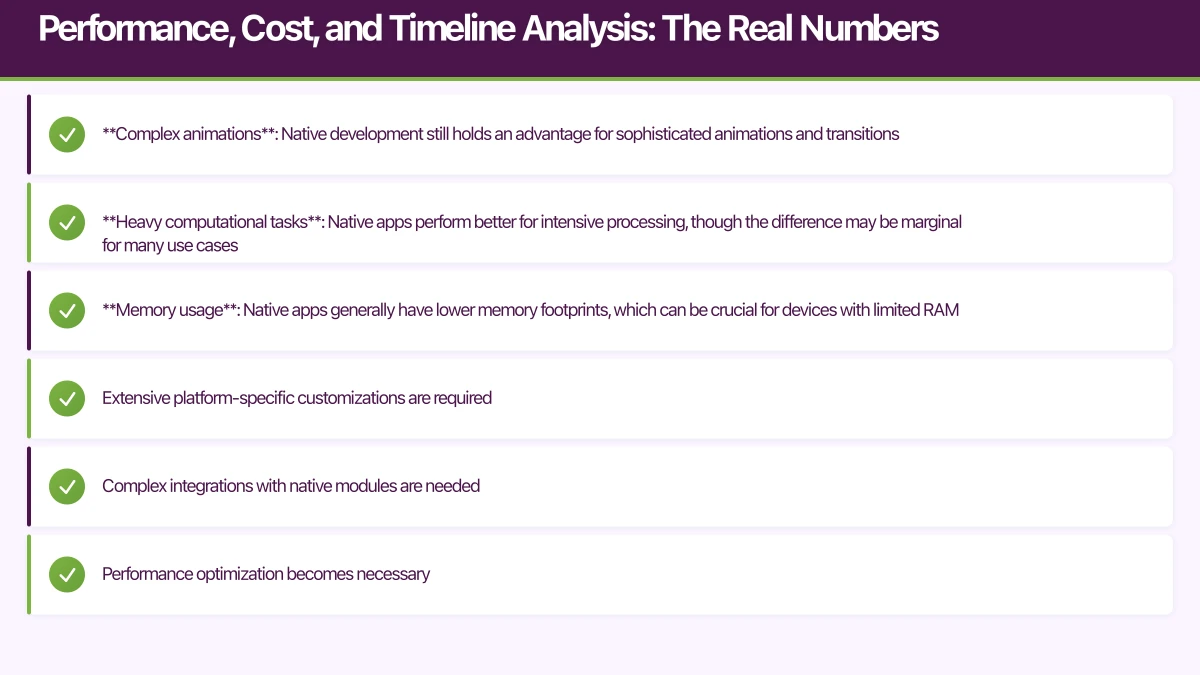
- Complex animations: Native development still holds an advantage for sophisticated animations and transitions
- Heavy computational tasks: Native apps perform better for intensive processing, though the difference may be marginal for many use cases
- Memory usage: Native apps generally have lower memory footprints, which can be crucial for devices with limited RAM
Development Timeline Reality
Cross-platform development can reduce initial development time by 30-50% compared to building separate native applications. However, this advantage diminishes when:
- Extensive platform-specific customizations are required
- Complex integrations with native modules are needed
- Performance optimization becomes necessary
Total Cost of Ownership
While cross-platform development offers lower initial costs, the total cost of ownership depends on several factors:
- Maintenance complexity: Cross-platform apps may require updates when underlying frameworks change
- Team expertise: Native development requires separate iOS and Android expertise, while cross-platform allows for shared knowledge
- Platform-specific modifications: Cross-platform projects may eventually require native development for specific features
Long-term Considerations
Consider the lifecycle of your application:
- Scalability: How will your chosen approach handle growing complexity?
- Team growth: Will you be able to find developers with the required expertise?
- Platform evolution: How quickly can you adopt new platform features?
- Migration potential: How difficult would it be to change approaches if needed?
Making Your Decision: A Strategic Framework
Choosing between native and cross-platform development requires evaluating your specific project requirements, constraints, and long-term goals. Use this strategic framework to guide your decision-making process.
Project Assessment Matrix
Evaluate your project across these critical dimensions:
-
Performance Requirements
- Does your app require intensive computations or complex animations?
- Are you building a game or AR/VR application?
- Will users notice performance differences in your use case?
-
Platform Integration Needs
- Do you need access to cutting-edge platform features?
- Are platform-specific behaviors crucial for your user experience?
- Will you require deep integration with device hardware?
-
Resource Constraints
- What is your development budget?
- How quickly do you need to launch?
- What expertise does your team currently have?
-
Long-term Strategy
- How complex will your app become over time?
- Do you plan to expand to other platforms (web, desktop)?
- What are your maintenance and update requirements?
Decision Tree Approach
Start with these key questions:
- Is maximum performance critical? -> Consider native
- Do you need the latest platform features immediately? -> Consider native
- Is budget or timeline the primary constraint? -> Consider cross-platform
- Are you building a standard business application? -> Cross-platform may be suitable
- Do you have separate iOS and Android teams? -> Native might be more efficient
- Is this an MVP or proof of concept? -> Cross-platform offers faster validation
Hybrid Approaches
Consider that your choice doesn’t have to be absolute. Many successful applications use hybrid approaches:
- Start with cross-platform for rapid MVP development, then selectively move performance-critical features to native
- Use cross-platform for standard features and native modules for specialized functionality
- Develop core business logic in cross-platform while maintaining native shells for platform-specific user experiences
Conclusion: Your Path Forward in 2025
The native vs cross-platform decision in 2025 is more nuanced than ever before. Cross-platform frameworks have matured to the point where they’re viable for a wide range of applications, while native development continues to offer advantages in performance and platform integration.
Key Takeaways:
-
Performance gaps are narrowing: For most business applications, cross-platform performance is acceptable and often indistinguishable from native.
-
Consider your specific needs: Your decision should be based on your unique requirements, not general assumptions about either approach.
-
Evaluate total cost of ownership: Look beyond initial development costs to consider long-term maintenance, updates, and potential migrations.
-
Team expertise matters: Choose an approach that aligns with your team’s skills or your ability to acquire the necessary expertise.
-
Hybrid approaches are valid: You don’t have to choose one approach exclusively - consider combining strategies based on feature requirements.
-
Start with your users: The best technical choice is the one that delivers the experience your users expect within your business constraints.
As you plan your 2025 mobile app project, remember that both native and cross-platform development can lead to successful applications. The key is choosing the approach that best aligns with your specific requirements, resources, and long-term goals.
At Awesome Apps, we’ve successfully delivered projects using both approaches. Our team can help you evaluate your specific needs and choose the development strategy that will best serve your users and business objectives. Whether you decide on native development for maximum performance or cross-platform for efficient multi-platform reach, the most important factor is execution excellence and a deep understanding of your users’ needs.
Your app needs secure, low-latency APIs. Cloud Geeks builds and manages cloud backends optimised for mobile applications.
Awesome Apps is the mobile development division of Ganda Tech Services, building iOS and Android apps for Australian businesses.
Talk to a Sydney app developer — free.
30 minutes. We'll tell you what your app needs, how long it takes, and what it costs. Real answers, no sales pitch.
Book Free App Strategy Call →Free · 30 minutes · No obligation