Mobile App Development: Retention Strategies That Actually Work
The average mobile app loses 77 percent of its daily active users within the first three days after install. By day 30, that number climbs to 90 percent. These are not bad apps in mobile app development. This is the default outcome when retention is treated as an afterthought.
Retention is the single most important metric for mobile app development success. Downloads measure interest. Retention measures value. A hundred thousand downloads with 2 percent Day-30 retention is worse than ten thousand downloads with 20 percent retention.
This guide covers the mobile app development retention strategies that have delivered measurable results for our clients’ apps. These are not theoretical frameworks. They are practical tactics backed by data.
Understanding Your Retention Curve
Before implementing any strategy, you need to understand your current retention curve. Plot the percentage of users who return on each day after install:
Day 0:  100%
Day 1:  35%
Day 3:  22%
Day 7:  15%
Day 14: 11%
Day 30: 8%
A healthy retention curve flattens. Users who survive the first week tend to stay. If your curve keeps declining without flattening, you have a product-market fit problem, not a retention problem. No amount of push notifications will fix an app that does not deliver value.
Benchmarks by Category
| Category | Day 1 | Day 7 | Day 30 |
|---|---|---|---|
| Social | 30-40% | 15-25% | 8-15% |
| Gaming | 35-45% | 15-20% | 5-10% |
| Productivity | 25-35% | 12-18% | 6-10% |
| E-commerce | 20-30% | 10-15% | 4-8% |
| Health/Fitness | 25-35% | 12-18% | 5-10% |
| News/Content | 25-35% | 15-20% | 8-12% |
Compare your numbers to these benchmarks. If you are significantly below, focus on the strategies for your weakest phase (early, mid, or late retention).
Phase 1: First-Session Experi
 ence (Day 0)
The first session determines whether users come back at all. You have roughly 60 seconds to demonstrate value.
Get to the Aha Moment Fast
Every app has an “aha moment”: the point where users first experience the core value. For a fitness app, it is completing their first workout. For a task manager, it is creating and checking off their first task. For a social app, it is connecting with someone they know.
Identify your aha moment by analysing which actions correlate most strongly with long-term retention. Users who perform Action X within their first session are Y times more likely to return on Day 7.
Then design your onboarding to drive users to that action as fast as possible.
Reduce Time to Value
Audit every step between app open and the aha moment. Remove anything that is not essential:
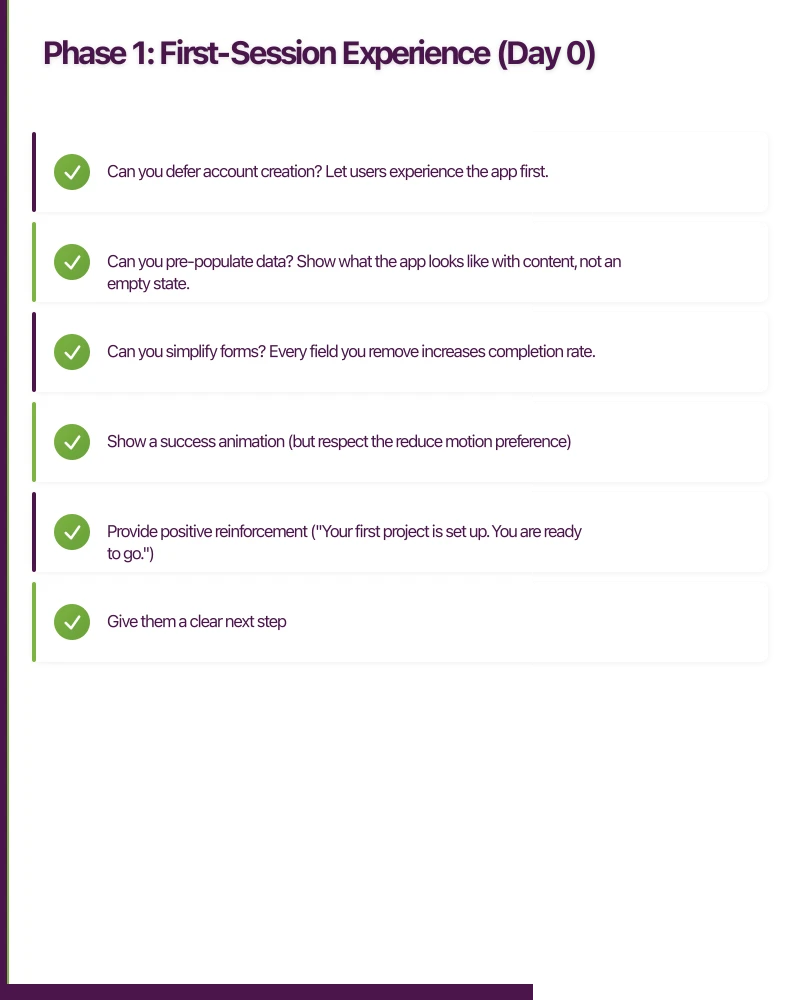
- Can you defer account creation? Let users experience the app first.
- Can you pre-populate data? Show what the app looks like with content, not an empty state.
- Can you simplify forms? Every field you remove increases completion rate.
One of our clients reduced their onboarding from 8 steps to 3. Day 1 retention increased from 28 percent to 41 percent.
Make the First Action Rewarding
When users complete their first key action, celebrate it:
- Show a success animation (but respect the reduce motion preference)
- Provide positive reinforcement (“Your first project is set up. You are ready to go.”)
- Give them a clear next step
The transition from first action to second action is where many apps lose users. Bridge that gap explicitly.
Phase 2: Building the Habi
 t (Days 1-7)
The first week is about transforming a single use into a habit. You need to create reasons for users to return.
Trigger-Action-Reward Loops
Habits form through repeated loops of trigger, action, and reward:
Trigger: Something prompts the user to open the app. This can be internal (feeling, need) or external (notification, email).
Action: The user performs the core behaviour (checks tasks, logs a workout, reads content).
Reward: The user receives value (sense of accomplishment, new information, social validation).
Design your app so that completing today’s action creates tomorrow’s trigger. A task manager that sends a morning summary of today’s tasks creates a daily trigger. A fitness app that tracks a streak creates internal motivation to maintain it.
Strategic Push Notifications
Push notifications are the most powerful external trigger, but only when used well. During the first week, send notifications that:
-
Remind users of incomplete actions. “You started setting up your project yesterday. Pick up where you left off.” (Day 1 after abandoned setup)
-
Celebrate milestones. “You have completed 5 tasks this week. You are building momentum.” (Day 3 to 5)
-
Deliver value. “Here is your daily summary: 3 tasks due today.” (Daily, if the user has set up content)
Do not send generic “We miss you” notifications. They signal desperation and provide no value.
Progressive Feature Discovery
Do not reveal all features at once. Introduce them gradually:
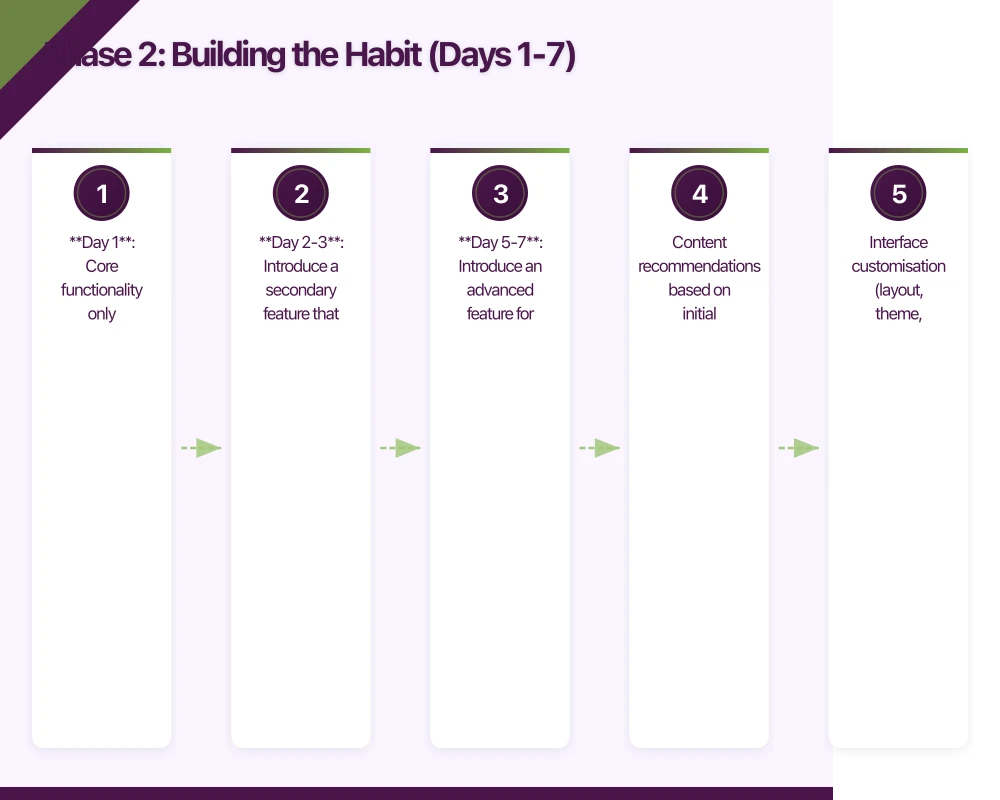
- Day 1: Core functionality only
- Day 2-3: Introduce a secondary feature that enhances the core experience
- Day 5-7: Introduce an advanced feature for engaged users
This creates a sense of ongoing discovery and gives users new reasons to engage.
Personalisation
The more personalised the experience, the more valuable the app feels. Use early behaviour signals to customise:
- Content recommendations based on initial interests
- Interface customisation (layout, theme, notification preferences)
- Relevant suggestions based on usage patterns
Phase 3: Sustained Engagement
 (Days 7-30)
Users who make it past the first week have found value. Now the challenge is maintaining engagement and building loyalty.
Streaks and Progress Tracking
Humans are motivated by visible progress. Implement mechanisms that make continued use feel rewarding:
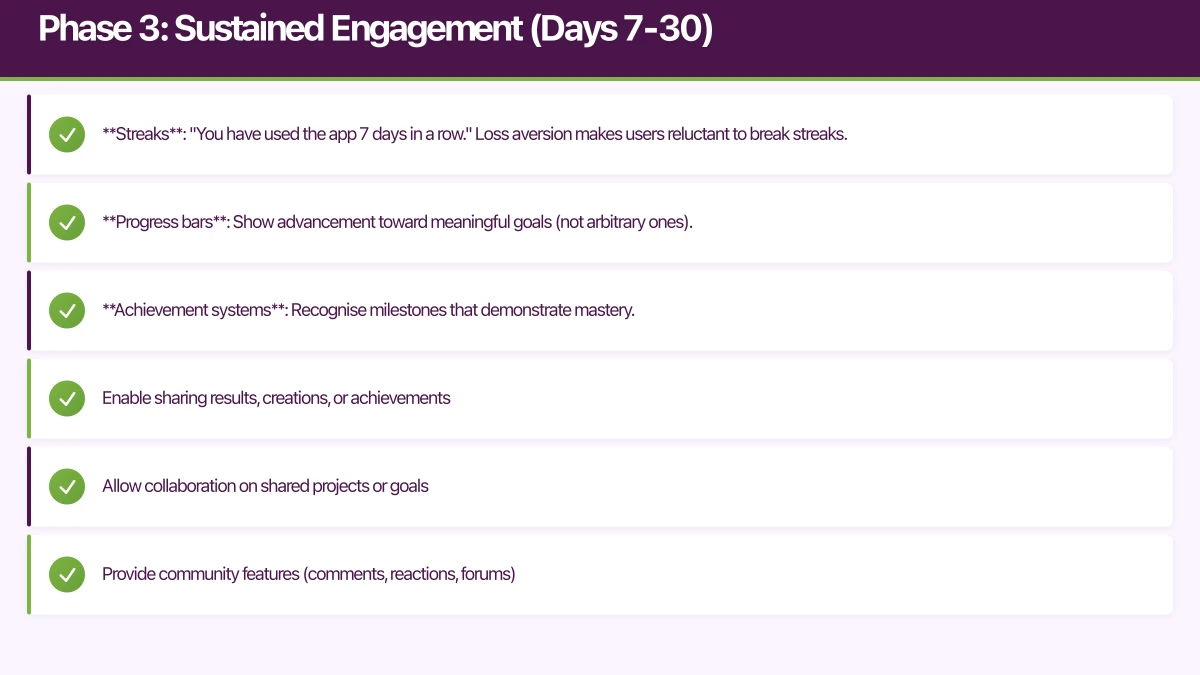
- Streaks: “You have used the app 7 days in a row.” Loss aversion makes users reluctant to break streaks.
- Progress bars: Show advancement toward meaningful goals (not arbitrary ones).
- Achievement systems: Recognise milestones that demonstrate mastery.
The key is authenticity. Progress should reflect real value delivered, not gamification for its own sake. A fitness app tracking consecutive workout days is motivating. A note-taking app awarding badges for opening the app is patronising.
Social Features
Social connections are the strongest retention driver. Users with social ties in an app are dramatically more likely to stay:
- Enable sharing results, creations, or achievements
- Allow collaboration on shared projects or goals
- Provide community features (comments, reactions, forums)
If your app does not have natural social features, consider social proof instead: “Join 5,000 Australian freelancers using this app.”
Regular Content and Feature Updates
Apps that stagnate lose users. Demonstrate ongoing investment:
- Ship visible improvements every 2 to 4 weeks
- Communicate updates through in-app changelogs
- Respond to user feedback visibly (“You asked for dark mode. Here it is.”)
Subscription Gates (Carefully)
For freemium apps, the transition from free to paid is a retention risk. Users who hit a paywall may churn instead of converting. Strategies to mitigate this:
- Ensure the free experience is genuinely valuable on its own
- Gate “nice to have” features, not core functionality
- Offer a free trial of premium before asking for payment
- Time upgrade prompts after users have experienced value, not before
Phase 4: Re-Engagement (30 days and beyond)
Some users will lapse. Re-engagement campaigns bring them back.
Lapse Detection
Define what “lapsed” means for your app. Common definitions:
- Has not opened the app in 7 days (for daily-use apps)
- Has not opened the app in 14 days (for weekly-use apps)
- Has not opened the app in 30 days (for monthly-use apps)
Re-Engagement Channels
Push notifications: The most direct channel. Only works if the user has not disabled them.
Email: Broader reach. Good for users who opted into email but disabled push notifications.
In-app messages: Shown on the next app open. Useful for users who return organically.
Re-Engagement Message Strategy
Effective re-engagement messages:
- What has changed: “3 new features since your last visit.” Give users a reason to return.
- What they are missing: “You have 5 unread messages.” Social notifications are highly effective.
- Personalised value: “Your weekly report is ready.” Deliver value that only your app provides.
- Special offers: “Welcome back. Enjoy 50 percent off premium for your first month.” Use sparingly.
Win-Back Flows
For lapsed subscription users, design a specific win-back flow:
- Day 3 after cancellation: “We are sorry to see you go. Your data is saved if you decide to come back.”
- Day 14: “We have made improvements since you left. Here is what is new.”
- Day 30: “Try premium again free for 7 days. No commitment.”
Measuring Retention Improvements
Cohort Analysis
Always measure retention by cohort. If you implement a change in week 3, compare the week-3 cohort’s retention to the week-2 cohort’s. Do not compare aggregate numbers.
Statistical Significance
Retention changes can be subtle. Ensure your sample sizes are large enough for statistical significance. Use a significance calculator. A 2 percent improvement that is not significant is just noise.
Leading Indicators
Retention is a lagging indicator. Track leading indicators that predict retention:
- Activation rate: Percentage of new users who reach the aha moment
- Feature adoption: Usage of features correlated with retention
- Session frequency: How often users return (increasing frequency predicts retention)
- Session depth: How much users do per session (deeper engagement predicts retention)
The Retention Framework
Summarising the complete retention strategy for mobile app development:
- Measure your current retention curve and identify the biggest drop-off point
- Optimise first-session experience to reach the aha moment faster
- Build habit loops with triggers, actions, and rewards during the first week
- Sustain engagement with progress tracking, social features, and regular updates
- Re-engage lapsed users with targeted, value-driven messages
- Iterate based on cohort analysis and leading indicator trends
Key insight for mobile app development: Apps that reduce time-to-aha-moment by 50% see 35-40% higher Day-1 retention compared to apps with lengthy onboarding.
Mobile app development best practice: Users with social connections in an app demonstrate 3-5x higher retention rates than solo users, making social features critical for long-term engagement.
Retention is not a one-time fix in mobile app development. It is an ongoing practice of understanding what keeps users coming back and relentlessly optimising for that. For deeper engagement strategies, explore our guides on push notification best practices and mobile app onboarding.
Frequently Asked Questions
What is a good retention rate for mobile app development?
Good retention rates vary by category in mobile app development. Day-1: 25-45%, Day-7: 12-25%, Day-30: 5-15%. Social apps average 30-40% Day-1 retention, gaming 35-45%, productivity 25-35%, and e-commerce 20-30%. Compare your retention curve to category benchmarks. A healthy retention curve flattens after the first week, indicating users have found value and are likely to continue using the app.
How do you improve Day-1 retention in mobile app development?
Improve Day-1 retention in mobile app development by reducing time-to-aha-moment. Identify the action correlating most with long-term retention and design onboarding to drive users there fast. Defer account creation, pre-populate data to avoid empty states, simplify forms, and celebrate first actions with positive reinforcement. Apps reducing onboarding from 8 steps to 3 steps see 10-15% Day-1 retention improvements.
What is an aha moment in mobile app development?
An aha moment in mobile app development is when users first experience core value. For fitness apps: completing first workout. For task managers: creating and checking off first task. For social apps: connecting with someone. Identify your aha moment by analyzing which first-session actions correlate with Day-7 retention. Design onboarding to drive users to this moment within 60 seconds of app open.
How do push notifications improve mobile app retention?
Push notifications improve mobile app development retention by creating external triggers for habit loops. Effective notifications during the first week: remind users of incomplete actions (Day 1), celebrate milestones (Days 3-5), and deliver personalized value (daily). Avoid generic “we miss you” messages. Strategic notifications increase Day-7 retention by 20-30% compared to apps without push notification strategies.
How do you re-engage lapsed users in mobile app development?
Re-engage lapsed users in mobile app development through multi-channel campaigns. Define lapsed (7-30 days inactive based on usage patterns). Send push notifications highlighting new features, email campaigns for users who disabled push, and in-app messages for organic returns. Effective messages focus on what changed, what users are missing, personalized value, or special offers. Win-back flows for subscription users should start Day 3 after cancellation.
A dedicated website amplifies your app’s reach. Cosmos Web Tech builds SEO-optimised sites that turn Google searches into app installs.
This article is brought to you by Ganda Tech Services — Sydney’s complete digital solutions provider covering cloud, web, and mobile.
Talk to a Sydney app developer — free.
30 minutes. We'll tell you what your app needs, how long it takes, and what it costs. Real answers, no sales pitch.
Book Free App Strategy Call →Free · 30 minutes · No obligation